Direct Response Vs Brand Awareness: Which is Best For Your Strategy?
Sammi Cohen • 10 August 2022

Whether you’re helping a small business owner or you’re trying to get new clients for your own agency, you’ll have to highlight how to solve customer problems. But that comes down to more than offering the best products and services for the best possible price. Sometimes, you may not even be looking to drive immediate sales. Depending on where the customer is in their buyer’s journey, you may need to take some specific steps to improve brand perception before someone is ready to make a purchase.


This all comes down to choosing between direct response marketing campaigns and building brand awareness. And while it’s entirely possible to do both at the same time, you’ll still need to decide whether a given part of your strategy falls under brand content marketing or under direct response digital marketing. Understanding the greater purpose of each strategic component can help you make stronger, smarter choices along the way.


If you’re feeling a little lost, don’t worry. As your white label SEO partner, we’re breaking down these terms to help you make the right moves for your agency and for your clients.

What is Brand Marketing?

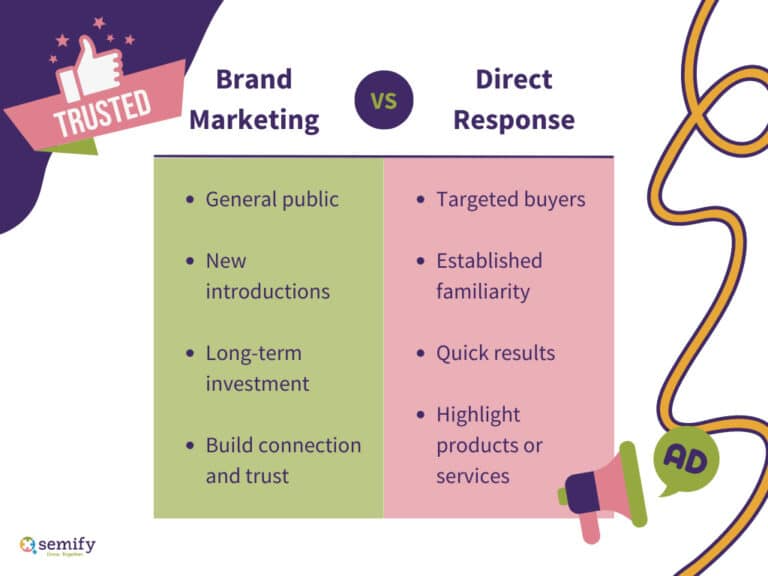
First, let’s talk about brand marketing. In its simplest form, brand marketing refers to how a business develops a relationship with its customers. The idea here is two-fold: to differentiate your brand from others in the marketplace and to build a real connection with consumers.

When you develop a brand content strategy, you won’t be focusing on the products or services the business provides. Rather, you’ll be coming up with ways to promote the brand as a whole. Generally, that involves establishing and highlighting the unique attributes of your brand in ways that resonate with and provide value for your target audience.


Why Does Brand Content Marketing Matter?

Think about some of the most well-known brands in the world – like Apple, McDonalds, and Nike – and ask yourself: are they loved and revered specifically for their products or services? Or are these offerings actually secondary to something greater?


Arguably, the most successful companies are selling something more than cell phones, hamburgers, and sneakers. They’re selling a lifestyle. A promise. A dream. Will the newest iPhone, a Big Mac, or a pair of Air Maxes really change your life? Probably not in any meaningful way. But if you’re a fan of these brands, you can’t resist the allure of what might be.


All three of these companies understand the importance of brand marketing. Of course, they know how to promote their latest releases. But the reason those releases are so successful is because there’s a solid foundation of brand marketing on which to build those promotions.


Brand marketing is what encourages emotional buy-in. Although we sometimes like to tell ourselves that brand loyalty is dead, that isn’t really true. It’s just a lot harder to come by these days. With so many options available, brands have to stand out from the crowd – and do more than merely sell a product. They need to sell what the brand represents.


There are a lot of companies out there that have managed to build their brand equity to the point where their customers won’t even think about looking elsewhere for similar products or services. From Trader Joe’s to Coca Cola, these brands manage to not only establish their own distinctive identities but actually become an integral part of their customers’ identities. Trader Joe’s fans are reluctant to shop elsewhere for groceries, while Coke drinkers would never be caught dead sipping on a Pepsi. That’s not necessarily because these products are objectively better; it’s because consumers identify with the brand itself.


So with that in mind, why does brand content marketing matter? Because without it, you’re just another business providing the same products or services as your competitor. When done well, brand marketing will strengthen a customer’s emotional connection to your company. And that’s what makes the difference between a one-time purchase and a lifelong buyer.

What’s Involved in Brand Marketing?

Getting your audience to love your products is one thing. But getting them to love your company is another. And because today’s consumers tend to be skeptical by default, it’s tougher than ever to convince buyers to make the leap and trust you.


Before anyone can even like your brand, however, it needs to be clearly established. If you’re confused about your brand attributes (like your visual identity, your values, your persona, your voice, and anything else that makes your brand unique), your prospects will be confused, too. It’s crucial to get into the nitty gritty of your brand and your audience before you attempt to market it. If you don’t know your brand like the back of your hand, you’re going to have a tough time convincing customers to come along for the ride.


This may require you to undergo a brand refresh or even a complete rebranding, in some cases. (We rebranded to Semify back in 2020, so we know how big an undertaking it is!) Your agency or your clients may not need a totally new name, but it may be worth exploring whether there are attributes that can be updated to accurately reflect the direction of the company. If the logo, tagline, mission statement, or overall ethos doesn’t speak to you, it definitely won’t speak to prospective customers.


Once you’re clear on what makes the brand unique, you’ll typically want to create a strategy around building brand awareness, brand loyalty, and other goals. Remember: the objective of brand marketing isn’t necessarily to directly make more sales. You might be more focused on improving web traffic, boosting your customer Net Promoter Score (NPS), increasing engagement on social media, or establishing authority through thought leadership.


What Are Some Common Brand Awareness Content Ideas?

Let’s say you’ve done all that prep work and are now in need of some brand awareness content ideas for your brand marketing strategy. Brand marketing content may involve:

  • The imagery, colors, font, and logos associated with your business
  • Infographics
  • Review management programs
  • Partnerships with other businesses
  • Sponsorships and charitable work
  • Branded product giveaways
  • Behind-the-scenes visual media
  • Social media contests
  • Case studies and ebooks
  • Informative blog posts
  • LinkedIn courses and published posts
  • Podcasts or webinars
  • Posts related to social or environmental causes


Can these tactics sometimes result in sales for the business? Sure. But that’s not the #1 goal. All of these examples can help brands connect on a deeper level with potential customers and position the company as a leader or even a friend.


According to a study from Sprout Social, that connection matters. Around 57% of consumers say they’ll increase their spending with a brand that they feel connected to, while 76% say this connection will convince them to buy from that brand over a competitor. When you prioritize brand marketing, you’ll ensure that the other aspects of your strategy are that much more effective.


That being said, brand marketing isn’t the only thing you’ll need for a successful strategy. Direct response marketing also has its place in promoting your agency or your clients’ businesses.

What is Direct Response Marketing?

Direct response marketing, sometimes called direct response advertising, intends to elicit (you guessed it) a direct response from a customer – namely, a sale. Rather than having a goal of increasing general awareness, direct response marketing is all about influencing behavior directly and immediately.


Unlike with brand marketing, direct response marketing campaigns will usually feature more of a “hard sell.” It’s not meant to be subtle; while direct response marketing can be educational and will demonstrate value, it’s also intended to drive results almost instantaneously. As the name suggests, there should be a direct and identifiable link between the promotion and the desired result (i.e., web traffic and/or sales).


Why Use Direct Response Marketing?

Although many of today’s customers don’t like obvious sales tactics, direct response digital marketing is both appropriate and necessary in a number of scenarios. It’s generally a more effective option when a brand is trying to influence certain behaviors or attain more quantifiable, immediate goals. If there’s a sense of urgency surrounding your desired outcome, chances are good that direct response marketing may be the right choice.


Whether you’re trying to generate more leads, sell more products, or get more folks to sign up for your email blasts, you’ll want something with a strong call-to-action. CTAs are a hallmark of direct response marketing campaigns because they tell the customer exactly what you want them to do next. Instead of an open-ended, informative article that may show your brand in a positive light, you’re guiding the consumer through their buyer’s journey with your company.


Not only does direct response tend to produce faster results, but those results are also easier to track. While there are KPIs that can measure brand awareness and loyalty, they may be a bit more subjective or out of your control. With direct response marketing, on the other hand, you can see exactly how successful each campaign is and how much you’re spending to target each customer. On that note, direct response marketing provides more accurate targeting and personalization than brand marketing. Because you’ll have more data at your disposal, you can reach specific audiences more effectively – resulting in greater conversions.

What Are Some Direct Response Internet Marketing Examples?

Direct response marketing might make you think of your basic advertisement, but it’s more than that. Here are just a few direct response internet marketing examples you might already be familiar with:

  • Product and landing pages
  • Google Ads (PPC) or display advertising
  • Social media advertisements
  • Special offer email blasts or targeted emails (i.e., cart abandonment, remarketing)
  • New product launch announcements
  • Newsletter enrollment pop-ups
  • Customer referral programs
  • SMS (text message) marketing
  • Chatbots and social media messaging platforms


It’s not just digital marketing that uses direct response principles. Materials like promotional mailers would also fall under the category of direct response marketing. Additionally, print ads, radio spots, and TV commercials would be categorized this way. While these might seem outdated, many businesses still use them to diversify their strategies and reach certain key demographics.


Branding Vs Direct Response: Which Should You Choose?

Understanding the difference between direct response marketing vs branding is only half the battle. You’ll need to know which type of marketing to focus on at any given point in your strategy – and that choice isn’t always as straightforward as it might seem. Here are a few ways to determine which option is best for your needs.

Audience

Brand marketing is a great equalizer, allowing you to reach all kinds of people with a singular piece of content. When you’re looking to introduce your brand to the general public, brand marketing is the natural choice. But if you’re at the point where you need to target specific buyers, direct response marketing can help you segment your audience and zero in on the folks who are ready to purchase.


Buyer’s Journey

When a consumer isn’t yet familiar with your brand, you need to put in the legwork to build trust, authority, and likeability. That’s what brand marketing is all about. Before you ever try to sell them on a product or service, these prospects need to know and love you. But if they’ve already been introduced to your brand and made up their mind that they connect with you, it’s time for direct response marketing. Now that they’re further along in their buyer’s journey, they’ll be ready to hear why your offerings will change their lives for the better.


Timeline

In the SEO vs. PPC debate, one of the main differences is time efficiency. The comparison between brand marketing and direct response is similar. Both SEO and brand marketing take longer to build, but their effects are longer lasting. In contrast, PPC and other direct response marketing techniques have more immediate results. The downside is that after those campaigns have ended, you won’t keep driving sales or traffic. (This illustrates why you need both types of marketing in your strategy!) If you’re promoting a short-term offer, direct response should be your top priority. But you can’t rush building your brand awareness. As they say, Rome wasn’t built in a day.


Goals

One of the easiest ways to establish the winner in your branding vs direct response race? Zero in on exactly what you’re trying to accomplish. If you know you need to make a certain amount of sales as soon as possible, you may want to prioritize a direct response strategy. Not only will this highlight specific products or services, but you’re directing customers to take a very specific action (a.k.a. making a purchase). On the other hand, if you’re still trying to reach a certain demographic and you aren’t focusing on immediate sales, brand marketing might be the strongest choice. With your brand content marketing, you can build connections and trust with your audience without the pressure of a hard sell.


In Direct Response Marketing Vs Branding, It’s Not Either/Or

In the branding vs direct response argument, you don’t need to take only one side. You’ll ultimately need to cover both marketing types for any strategy, whether it’s for your own agency or on behalf of a client. But which one you choose at any given point will largely depend on the specific goals (both immediate and long-term) you want to achieve. And in many cases, you may be working on both at the same time!


When you partner with a white label SEO provider to outsource your client marketing, you’ll want to have a clear understanding of whether the content will be largely focused on branding and education versus direct response. Some pieces may have elements of both. By and large, though, the majority of optimized blog content will be geared towards building trust and providing value. On the other hand, content like web and ad copy will usually fall under the direct response umbrella.


In the end, one isn’t inherently better than the other. Each type of marketing serves a different purpose – and both are crucial to a successful strategy. When you decide to employ one over the other is a totally personal choice, but you should plan to include both when marketing any business online. And knowing which one to recommend or utilize at any moment will solidify your leadership as a marketer to watch.

Recent Posts

by Patrick Briggs 8 December 2025
Semify Acquires Leading Digital Marketing Reporting Platform Dragon Metrics to Accelerate Global AI Optimization Capabilities and Expand International Market Reach Strategic acquisition brings world-class SEO/AI/PPC reporting software platform and international expertise to leading white-label digital marketing software platform ROCHESTER, NY — December 8, 2025— Semify, a leading white-label digital marketing software platform specializing in Search Engine Optimization (SEO), Paid Search Advertising (PPC), Paid Social Advertising, and AI Optimization (AIO), today announced the acquisition of Dragon Metrics, an international SEO/AI/PPC reporting software platform based in Hong Kong. The strategic acquisition significantly expands Semify’s global measurement capabilities and accelerates its AI optimization offerings. Dragon Metrics, founded in 2011 by Simon Lesser (CEO and co-founder) and Richard Mabey (Advisor and co-founder), has built a reputation as the premier SEO platform for international markets. In addition to support for Google and AI platforms, Dragon Metrics also offers comprehensive support for massive non-Google markets including China, Korea, and Japan. The platform currently serves multinational companies and global agencies across more than 50 countries. “This acquisition represents a pivotal moment in our evolution toward comprehensive AI optimization services with best-in-class reporting software,” said Patrick Briggs, CEO of Semify. “Dragon Metrics brings not only world-class reporting technology but also deep expertise in international markets that will be crucial as AI optimization expands globally. Simon’s vision for AI-powered SEO, PPC, and social advertising reporting perfectly aligns with our AIO strategy, and having him join as our Chief Product Officer will accelerate our service and software development significantly.” As part of the acquisition, Simon Lesser will join Semify as Chief Product Officer, leading the company’s AI optimization product strategy. The Dragon Metrics engineering team will integrate with Semify’s existing engineering team, led by CTO Brian Sappey. “Joining forces with Semify allows us to take Dragon Metrics to the next level by combining our international reporting expertise with Semify’s proven white-label fulfillment model,” said Simon Lesser, Co-founder and CEO of Dragon Metrics. “Our clients will now have access to full-service digital marketing execution, while Semify’s partners gain access to enterprise-grade reporting capabilities that rival any platform in the market.” The integration will provide immediate benefits to Semify’s Resellers, who will gain access to enhanced reporting features through a Dragon Metrics account and eventually, through Dragon Metric’s software, become integrated into Semify’s software. Under Semify’s program, partners can retain advanced reporting, content editing, and keyword research capabilities that eliminates the need for multiple SEO software tools. For existing Dragon Metrics customers, Dragon Metrics will continue as a standalone brand with additional engineering support and white-label fulfillment services available only to Dragon Metrics-approved agency customers to adhere to Semify’s Reseller model. “This acquisition perfectly illustrates the convergence we’re seeing between sophisticated SEO, PPC, social ad, and AI-powered reporting,” said Richard Mabey, Co-founder of Dragon Metrics. “The combination of Dragon Metrics’ global capabilities with Semify’s AIO and SEO expertise creates a uniquely powerful platform.” The acquisition comes at a critical time as search marketing evolves rapidly toward AI-powered experiences. Semify has been pioneering the AIO (AI Optimization) methodology. Dragon Metrics’ existing AI Overview tracking capabilities and international market expertise will accelerate Semify’s ability to deliver AIO services globally. About Semify Semify is a leading white-label digital marketing platform that helps organizations scale their SEO, PPC, and AI Optimization services. Founded in 2009, Semify enables growth by plugging directly into existing ecosystems, consolidating marketing stacks, and supporting product fulfillment without requiring changes to current operations. Semify’s unique blend of expert service from a US-based team and cutting-edge software platform with enterprise API enables efficient service delivery at scale. The company is pioneering AI Optimization (AIO) methodologies and is renowned for its commitment to constant innovation in the white-label digital marketing space and providing its partners with best-in-class marketing solutions. For more information, visit www.semify.com . About Dragon Metrics Founded in 2011 and headquartered in Hong Kong, Dragon Metrics is a comprehensive SEO/AI/PPC reporting platform designed for international markets. The company specializes in providing enterprise-grade SEO tools with exceptional support for both Google and additional search engines popular in China, Korea, and Japan. Dragon Metrics serves multinational companies and global agencies across more than 50 countries, offering features including AI overview tracking, keyword rank monitoring, competitor analysis, content optimization, technical site audits, and backlink analysis. For more information, visit www.dragonmetrics.com . Media inquiries: Valerie Silverman Kerr VSK Public Relations valerie@vsk-publicrelations.com 914-806-6647
by Nicole Jarvey 4 September 2025
How to Outsource SEO in a Successful Way When you outsource SEO, it’s not that you are only physically losing control of your marketing, but that you have no way of knowing whether the same strategy is being put into place. Are you looking to boost your search rankings, attract better leads, or find new customers? Good objectives will also allow your SEO partner to develop a plan that reflects your vision. After you know what you need to accomplish, vet providers thoroughly. Your best bet is to find a reputable SEO agency, like Semify , that provides results, honest reporting, and good communication. We will provide a full range of services from keyword research and link building to technical audits and content optimization. We can help you choose the plan that aligns with your budget and stage of growth, whether you are a single business looking to scale or an agency handling multiple clients. When done right, outsourcing is a partnership where you continue to do what you do best, but let specialists, like us, handle the nitty-gritty of the technology behind getting measurable results. Should You Outsource SEO? The idea of in-house management of SEO sounds like a great thing until you realize how much work it really is. It’s not just about keeping an eye on what the competition is doing; you need to grow it and generate consistent content, or you can quickly be left behind. Many businesses find that in-house staff just don’t have the time or proficiency to manage it effectively. If you’ve ever felt at a loss for staying abreast of Google’s shifting algorithms, or if the responsibilities of SEO consistently end up at the bottom of your to-do list, then handing it over to us could be the best approach. Using Semify will allow you to open up time while leading the rest of the experts who know how to grow your business. The Benefits of Outsourcing SEO Outsourcing SEO gives you access to expertise, and that’s one of the most significant benefits of outsourcing with Semify. Instead of trial and error, you get a team that lives and breathes SEO and stays on top of algorithm updates and what’s new in the industry. This not only saves you from expensive mistakes but also expedites the results. Another key benefit is scalability. As your business or agency scales, though, your SEO needs will change. We can be flexible and scale up in terms of content production, link building, or technical support on short notice—whereas you’d typically have to spend time and money hiring (and possibly even training) new staff otherwise. The potential for cost savings also adds to the appeal of outsourcing. You have a salary and benefits, and perpetual training for your in-house people. In comparison, outsourcing affords you a complete team of professionals at a fraction of the expense. And because reputable carriers are transparent with information and have detailed reporting, you will always know the dashboard kind of view into how your campaigns are doing and where your dollars are going. In short, outsourcing SEO can save you time, give you more control over the costs, and, most importantly, drive better long-term results than in-house teams can routinely achieve on their own. Why You Should Consider Semify for Your SEO Services Not all SEO services are created equal, so who you choose to partner with matters. At Semify, we pride ourselves on being one of the most successful companies in providing white label SEO that has been proven through years of experience to help your agency unlock the potential of its online presence. There are a couple of reasons companies rely on us to do their SEO: We offer clear reporting, so you know where you stand at all times. Our approaches are rooted in long-term growth — not short-term, patch-the-holes measures. We see clients as partners, discovering what drives their business goals and sustained success — not just gaining short-term victories. Whether you are from an agency looking to expand services for multiple clients or are a single business that wants to increase visibility, we have a flexible and scalable plan for you. The Bottom Line So, should you outsource SEO? For a lot of businesses, the answer is yes. With the time and money-saving and expert strategy-building benefits it has to offer, outsourcing SEO is one of the soundest investments you can make for your growth. If you’re having to choose a provider, Semify is a partner you can trust. We bring together transparency, expertise, and scalable solutions whilst keeping it real and delivering tangible results. SEO Reseller Services - Call Semify today to outsource SEO.
by Nicole Jarvey 8 May 2025
Improving your website’s authority is essential if you want to rank higher in search engines and build long-term digital credibility. While paid SEO tools and services can speed up the process, there are plenty of ways to strengthen your site’s authority without spending a single dollar. Here are 19 actionable and completely free strategies to boost your domain authority (DA) and online presence. 1. Create High-Quality, Shareable Content Content is the cornerstone of a successful SEO strategy. To improve your visibility in search engines and engage your target audience, focus on producing content that is: In-depth: Go beyond surface-level information by thoroughly exploring your topics. Original: Provide unique insights or perspectives that set your content apart. Highly Relevant: Directly address the specific needs, questions, and pain points of your readers. To achieve this, be sure to: Support your points with credible sources to build authority and trustworthiness. Offer practical takeaways or solutions that users can apply immediately. High-quality content benefits your SEO in several ways: Build trust with your audience, encouraging them to return and engage with your site. Increases the likelihood of earning valuable backlinks from other websites that reference your content. Encourages social shares, helping your content reach a broader audience. When your content provides genuine value and stands out in your niche, it naturally attracts attention. This leads to: Other websites linking to you, enhancing your domain authority. More users sharing your content across platforms increases visibility. Improved search engine rankings and stronger online authority overall. 2. Start a Blog on Your Domain Launching a blog on your domain is a powerful way to enhance your website’s SEO and establish your brand as a trusted authority in your niche. A regularly updated blog allows you to: Consistently publish fresh, relevant content that keeps your site active in the eyes of search engines. Signal to search engines that your website is alive and providing ongoing value, which can positively impact your rankings. Blogging also creates an ideal platform to: Target long-tail keywords —these are more specific and often lower-competition search phrases your potential customers use on Google. Attract more qualified traffic by crafting content that directly addresses these specific queries, often reaching users further along in the buyer journey. Maintaining a blog helps you: Demonstrate topical expertise through comprehensive and insightful posts. Establish credibility in your field, building trust with your audience. Encourage return visits from readers who find your content valuable. Increase engagement, shares, and backlinks —all essential components of strong SEO performance. 3. Optimize On-Page SEO On-page SEO involves optimizing individual pages on your website to help search engines understand your content and improve your rankings. Paying close attention to key elements on each page not only boosts visibility but also enhances user experience. Be sure to include the following components: Meta Title : Create a unique and keyword-rich meta title for each page. This title appears in search engine results and should accurately reflect the page’s topic to encourage clicks. Meta Description : Write a clear and compelling meta description that summarizes the page’s content. While it doesn’t directly impact rankings, it can significantly influence your click-through rate. Header Tags (H1, H2, H3, etc.) : Use header tags to structure your content logically. The H1 tag should be used for the main title, followed by H2s and H3s for subheadings. This helps search engines and users navigate your content more easily. Image Alt Text : Add descriptive alt text to all images. This improves accessibility for users with visual impairments and helps search engines understand and index your visual content. Internal Linking : Link to related pages within your website. Internal links keep users engaged, guide them through your content, and help distribute page authority across your site. By optimizing these on-page elements, you make it easier for search engines to crawl and rank your content, while also improving the overall experience for your visitors. 4. Earn Backlinks Through Guest Posting Guest posting is a powerful and strategic way to earn free backlinks for your website , which are essential for improving your website’s authority and search engine rankings. This tactic involves reaching out to other reputable blogs, websites, or online publications within your industry or niche and offering to contribute valuable, well-written content that aligns with their audience’s interests. When your guest post is accepted and published, you typically include a backlink to your website, either within the content itself or in the author bio section. These backlinks act as a vote of confidence in the eyes of search engines, signaling that your site is trustworthy and relevant, which can significantly boost your SEO. Here’s how to make the most of guest posting: Identify Relevant Websites : Look for websites and blogs in your niche with a strong domain authority and engaged audience. Pitch Thoughtfully : Reach out with personalized pitches that highlight your expertise and suggest unique topic ideas tailored to their readers. Provide High-Quality Content : Ensure your guest posts are original, informative, and actionable. The better the quality, the more likely the post will be accepted and shared. Include Natural Backlinks : Strategically include a link to a relevant page on your site where it fits organically, offering additional value to readers. Build Relationships : Treat guest posting to build long-term relationships with editors, bloggers, and influencers in your industry. Consistently contributing guest posts not only helps you build a diverse backlink profile but also increases your brand exposure, drives referral traffic, and positions you as an authority in your field. 5. Use Internal Linking Strategically Internal linking is a crucial SEO practice that involves connecting related posts, pages, and other content within your website. By thoughtfully linking your content, you create a clear pathway for both users and search engines to navigate your site more efficiently. For users, internal links guide them to additional relevant information, keeping them engaged longer and enhancing their overall experience. This can reduce bounce rates and increase the chances of conversions, whether that means making a purchase, signing up for a newsletter, or exploring other valuable resources you offer. From an SEO perspective, internal linking helps search engines understand the hierarchy and relationship between different pages on your site. This improves the way search engines crawl and index your website, ensuring that your most important pages receive the attention they deserve. Internal links help distribute page authority (or “link juice”) across your site, boosting the ranking potential of key pages. To use internal linking effectively: Link related blog posts, product pages, or service pages where relevant. Use descriptive anchor text that shows what the linked page is about. Avoid over-linking; only include links that provide genuine value and context. Regularly audit your site to fix broken links and update outdated links to maintain a healthy site structure. When done strategically, internal linking not only improves SEO but also enhances user experience and encourages visitors to explore more of your content. 6. Claim and Optimize Your Google Business Profile If you run a local business, claiming and optimizing your Google Business Profile (formerly Google My Business) is one of the most effective ways to boost your visibility in local search results. This free tool allows your business to appear in Google Maps and the local “pack” results, which are prominently displayed when users search for services or products near them. To optimize your Google Business Profile effectively, make sure to: Provide complete and accurate business information , including your address, phone number, business hours, and website link. Write a detailed description of your products or services that highlights what makes your business unique. Add high-quality photos of your storefront, products, or team to make your profile more appealing. Post regular updates or special offers to engage potential customers and keep your profile fresh. Encourage satisfied customers to leave positive reviews , which boosts your credibility and influences search rankings. Respond promptly to all reviews , both positive and negative, to show that you value customer feedback and maintain active engagement. By maintaining a well-optimized Google Business Profile, you increase your chances of appearing at the top of local search results, drive more foot traffic to your physical location, and enhance overall trust and credibility with your audience. 7. Take Part in Industry Forums and Q&A Sites Engaging actively in industry-specific forums, Q&A platforms like Quora and Reddit , and niche online communities is a valuable strategy to build your reputation and expand your online presence. These sites provide excellent opportunities to show your expertise by answering questions, sharing insights, and contributing to meaningful discussions related to your field. By consistently offering helpful and knowledgeable responses, you can establish yourself or your brand as a trusted authority within your niche. This not only builds credibility among community members but also drives targeted traffic back to your website when you link to relevant content. However, it’s important to be genuine and avoid spamming or overly promotional behavior, as these communities value authenticity and helpfulness. To maximize the benefits of participating in these platforms: Identify relevant forums and Q&A sites that align closely with your industry and target audience. Create a complete and professional profile to build trust and recognition among community members. Contribute high-quality, detailed answers that provide real value rather than short or generic responses. Include links to your website or blog only when they are highly relevant and add value to the conversation. Engage regularly to build relationships and stay visible within the community. Follow each platform’s rules and guidelines to avoid penalties or being banned. By actively participating in industry forums and Q&A sites, you not only generate potential backlinks and referral traffic but also deepen your understanding of your audience’s needs and challenges, which can inform your broader content and marketing strategies. 8. List Your Website on Free Directories Submitting your website to credible online directories is an effective way to improve your SEO and increase your site’s visibility. There are many reputable directories, such as Crunchbase, Hotfrog, Yelp, and others, that offer free business listings. These directories serve as trusted sources that search engines often rely on to verify and validate your business information. By listing your website on these platforms, you not only gain valuable backlinks that can help boost your domain authority but also increase the chances of potential customers discovering your business through different channels. Many directories include user reviews, ratings, and detailed business descriptions, which further enhance your brand’s credibility and reputation. To maximize the benefits: Ensure your business information is consistent and accurate across all directory listings. Complete every section, including your business name, address, phone number, website URL, hours of operation, and an interesting description. Choose directories that apply to your industry or geographic location for more targeted exposure. Monitor and respond to customer reviews to engage with your audience and maintain a positive online reputation. Overall, listing your website on free, credible directories is a straightforward yet powerful tactic to improve your SEO, increase online visibility, and attract more qualified traffic to your site. 9. Engage in Broken Link Building Broken link building is a highly effective SEO strategy that involves identifying broken or dead links on other websites within your niche and offering your relevant content as a replacement. When webmasters encounter broken links on their sites, they often appreciate helpful suggestions to fix them, especially when you provide a useful, high-quality resource to replace the dead link. This method not only helps improve the user experience on their site but also allows you to earn valuable backlinks that can boost your website’s authority and search engine rankings. To get started with broken link building: Use tools like Ahrefs Broken Link Checker (which offers a free plan) to scan relevant websites for broken links. Identify broken links that are related to your niche or content area to ensure your suggested replacement is relevant and valuable. Reach out politely to the website owner or webmaster, informing them of the broken link and recommending your content as a suitable alternative. Provide clear explanations and links to your content to make it easy for them to update their site. This approach benefits both parties: webmasters improve their site’s user experience by fixing broken links, and you gain high-quality backlinks with no paid advertising or complicated outreach. Broken link building helps you build relationships with other website owners, potentially opening doors to further collaboration and guest posting opportunities. 10. Leverage HARO (Help a Reporter Out) HARO , which stands for Help a Reporter Out, is a valuable platform that connects journalists and bloggers with expert sources for their stories. By signing up as a source on HARO, you gain the opportunity to respond to media queries relevant to your industry or expertise. This is a powerful way to gain exposure and earn backlinks from reputable, high-authority websites, which can significantly boost your SEO and credibility. Here’s how to effectively leverage HARO: Sign up as a source on the HARO platform to receive daily emails containing queries from journalists seeking expert insights or quotes. Monitor queries closely and respond promptly with well-crafted, informative, and relevant answers tailored to the journalist’s request. Provide simple contact information and a brief bio that highlights your credentials to increase your chances of being selected. Be concise and professional in your pitches, focusing on delivering value and expertise that directly addresses the query. If your pitch is used in an article, you typically receive a mention along with a backlink to your website, which can drive referral traffic and improve your search engine rankings. By regularly engaging with HARO, you not only build your brand’s authority and reputation but also develop relationships with journalists and influencers who might feature you again in future stories. It’s a cost-effective way to secure high-quality backlinks from well-established media outlets, enhancing your site’s domain authority and trustworthiness. 11. Promote Content on Social Media Sharing your content on social media platforms such as LinkedIn , X (Formerly Twitter) , Facebook , Instagram , and niche-specific networks is an essential part of any effective SEO strategy. Social media promotion increases your content’s visibility far beyond your website visitors, allowing you to reach a broader and more targeted audience. The more exposure your content receives, the higher the chances it will be noticed, shared, and linked to by other websites, bloggers, or influencers. Here’s why promoting your content on social media matters: Increases visibility: Social platforms have massive user bases where your content can quickly gain traction if it resonates with the audience. Drives targeted traffic: Sharing content in relevant groups, communities, or niche networks attracts users who are genuinely interested in your topic. Encourages engagement: Likes, shares, comments, and discussions increase your content’s reach and can improve its perceived value by search engines. Boosts backlink potential: When your content is widely shared, bloggers, journalists, and webmasters are more likely to discover and link to it, enhancing your SEO. Builds brand awareness: Consistent social media activity helps establish your brand as a trusted authority and fosters relationships with your audience. To maximize the effectiveness of social media promotion: Tailor your posts to each platform’s style and audience preferences. Use engaging visuals, compelling headlines, and clear calls to action. Participate in relevant groups and communities to share your content with interested users. Collaborate with influencers or industry leaders to amplify your reach. Track engagement metrics to understand what types of content perform best and refine your strategy. By actively promoting your content across social media channels, you create a multiplier effect that increases exposure, drives more organic traffic, and improves your website’s chances of earning valuable backlinks and higher search rankings. 12. Collaborate With Other Creators Partnering with other content creators—whether bloggers, podcasters, influencers, or industry experts—is a powerful strategy to expand your brand’s reach and boost your SEO efforts. Collaboration can take many forms, including co-authoring blog posts, participating in interviews, guest appearances on podcasts, or contributing to expert roundups. These joint ventures expose your brand to new and relevant audiences who might not have discovered you otherwise. By working together, both parties benefit from shared expertise, increased content variety, and cross-promotion opportunities that can lead to higher engagement and traffic. Collaborations often result in backlinks to your website, which are valuable for improving your domain authority and search engine rankings. To make the most of creator collaborations: Identify partners whose audience aligns with your target market and whose content complements your niche. Propose ideas that offer mutual value, such as insightful blog posts, engaging podcast topics, or collaborative video content. Promote the collaborative content across your channels and encourage your partner to do the same, maximizing visibility. Build long-term relationships by maintaining communication and exploring future opportunities together. Collaborating with other creators not only helps you tap into new networks but also enhances your credibility and authority in your industry. It’s an effective way to grow your online presence organically and generate high-quality backlinks through authentic and valuable partnerships. 13. Add Schema Markup Implementing schema markup—also known as structured data—is a highly effective SEO tactic that helps search engines better understand the content and context of your web pages. Schema is a form of code (usually written in JSON-LD format) that you can add to your website’s HTML to define specific types of information, such as product details, reviews, FAQs, events, local business info, and more. By using schema markup, you enable your content to appear more prominently in search engine results through rich snippets—enhanced listings that can include elements like star ratings, prices, publication dates, breadcrumbs, and other eye-catching features. These rich results can dramatically increase your click-through rates (CTR), drive more qualified traffic, and improve user experience by helping users find what they need more efficiently. Here are the key benefits of adding schema markup: Improved visibility: Rich snippets help your listings stand out in crowded search results. Higher click-through rates: Enhanced listings often attract more attention and engagement from users. Better content comprehension: Search engines can categorize and index your pages more accurately. Support for voice search and AI tools: Structured data helps smart assistants retrieve precise answers from your content. Local SEO boost: Local businesses can benefit from LocalBusiness schema to highlight location-specific details. Popular types of schema you can use include: Article or BlogPosting for blog content Product for eCommerce pages FAQPage for frequently asked questions Event for promoting upcoming events Review and AggregateRating for testimonials LocalBusiness for service-based companies Adding schema markup doesn’t guarantee rich results, but it significantly increases your chances. You can use tools like Google’s Structured Data Markup Helper or Schema.org to get started, and always test your markup using Google’s Rich Results Test. 14. Encourage User-Generated Content (UGC) User-generated content (UGC) refers to any form of content, such as reviews, testimonials, blog comments, forum posts, photos, videos, or social media mentions, that is created and submitted by your users or customers, rather than your brand. Encouraging UGC is a powerful way to keep your website fresh, dynamic, and engaging while also boosting your SEO performance. Search engines favor websites that consistently publish new, relevant content. UGC naturally contributes to this by continuously adding fresh material to your site without requiring you to create it all yourself. Whether it’s a customer leaving a review on a product page or a user posting in a discussion forum, this type of content increases keyword diversity, enhances topic depth, and signals community engagement—factors that can help improve your site’s rankings. Benefits of encouraging user-generated content include: Improved SEO performance: Fresh content keeps your pages active and helps target long-tail keywords organically. Increased time on site: Visitors are more likely to engage with content written by fellow users, which reduces bounce rates and increases session duration. Higher trust and credibility: Reviews, testimonials, and community discussions add authenticity and social proof. More inbound links and shares: Users often share their contributions, driving traffic and potential backlinks. Valuable insights: UGC helps you better understand your audience’s needs, preferences, and language, which can inform your future content strategy. Ways to implement and encourage UGC on your site: Enable product or service reviews and ratings. Allow and moderate blog comments to foster discussion. Feature customer testimonials or case studies. Create community forums or Q&A sections. Run social media campaigns that invite users to share content with a branded hashtag. Offer incentives or recognition (like contests or featured posts) to motivate contributions. By actively promoting user participation and making it easy for users to contribute, you not only enrich your site with valuable content but also build a more loyal and involved audience. 15. Make Your Site Mobile-Friendly Ensuring your website is mobile-friendly is no longer optional—it’s essential. With most web traffic now coming from smartphones and tablets, providing a seamless mobile experience is critical for both user satisfaction and search engine rankings. Mobile usability is a confirmed ranking factor in Google’s algorithm, and sites that don’t perform well on mobile devices are likely to see lower visibility in search results. A mobile-friendly website is one that adapts to any screen size, loads quickly, and maintains usability across a range of devices. This includes responsive design, readable text without zooming, intuitive navigation, properly scaled images, and buttons that are easy to tap without accidental clicks. Benefits of a mobile-optimized site include: Improved SEO performance: Google uses mobile-first indexing, which means it primarily uses the mobile version of your site for indexing and ranking. Enhanced user experience: Visitors are more likely to stay on your site and engage with your content if it functions smoothly on their device. Lower bounce rates: A responsive, fast-loading mobile site reduces frustration and encourages visitors to explore more pages. Wider reach: A mobile-friendly site ensures accessibility for users on any device, increasing your potential audience. Increased conversions: A better mobile experience can lead to higher conversion rates, especially for e-commerce or lead-generation websites. To evaluate and improve mobile usability: Use Bing’s Mobile-Friendly Test to quickly identify any issues. Implement responsive design so your layout adapts fluidly to various screen sizes. Optimize images and assets for faster mobile loading. Avoid intrusive interstitials and pop-ups that disrupt the mobile experience. Ensure touch elements (buttons, links, forms) are sized appropriately and spaced out to prevent misclicks. Investing in mobile optimization not only aligns with current user behavior but also strengthens your site’s overall performance, accessibility, and competitiveness in search rankings. 16. Improve Page Load Speed Page load speed plays a critical role in both user experience and SEO performance. In today’s fast-paced digital world, users expect websites to load within just a few seconds—and if your site is slow, they’re likely to abandon it and move on to a competitor. From an SEO perspective, Google uses page speed as a ranking factor, meaning a sluggish site could harm your position in search results. A faster-loading website not only improves engagement but also boosts metrics like time on site, pages per session, and conversion rates. Plus, search engines are more likely to crawl and index your pages efficiently if they load quickly. To enhance your website’s load speed, focus on the following key strategies: Compress images: Use tools like TinyPNG or ImageOptim to reduce image file sizes without sacrificing quality. Minimize HTTP requests: Limit the number of elements on your page (scripts, stylesheets, images) to decrease the time it takes for the browser to load content. Leverage browser caching: Store frequently used resources in the user’s browser so they don’t have to be downloaded again on repeat visits. Use a lightweight, performance-optimized theme: Choose themes that are well-coded and optimized for speed, especially if you’re using platforms like WordPress. Minify CSS, JavaScript, and HTML: Remove unnecessary characters and spaces to streamline file sizes and reduce load time. Enable lazy loading: Delay the loading of images and other media until they are needed (i.e., when a user scrolls to them). Implement a content delivery network (CDN): Distribute your content across global servers to deliver it faster to users based on their geographic location. Choose fast, reliable hosting: Your web host’s server speed and performance play a huge role in how quickly your pages load. You can use tools like Google PageSpeed Insights , GTmetrix , or Pingdom to analyze your site’s speed and receive actionable recommendations for improvement. Optimizing page load speed is a win-win—it creates a better experience for your visitors and signals to search engines that your site is technically sound and user-friendly. 17. Submit Your Sitemap to Google Search Console Submitting a sitemap through Google Search Console is a simple yet highly effective way to ensure that your website’s content is properly discovered, crawled, and indexed by Google. A sitemap is essentially a file—usually in XML format—that lists all the important URLs on your website, including pages, blog posts, videos, and images. It acts like a roadmap for search engines, guiding them through the structure of your site. While Google can find pages on its own through internal and external links, manually submitting a sitemap gives you more control and ensures that all of your content, especially newly published or hard-to-find pages, is noticed more quickly and accurately. Benefits of submitting your sitemap include: Faster indexing of new content: When you publish new pages or posts, submitting your sitemap can help Google discover and index them faster. Improved crawl coverage: Search engines are more likely to find every important page, even those that aren’t easily accessible through internal links. Transparency and insights: Google Search Console provides feedback on which URLs were indexed successfully and highlights any errors or issues in your sitemap. Better structure recognition: A sitemap helps Google understand your site hierarchy, which can enhance how your content appears in search results. To submit your sitemap: Create a sitemap: Most CMS platforms (like WordPress with SEO plugins such as Yoast or Rank Math) autogenerate a sitemap for you (e.g., yoursite.com/sitemap.xml). Verify your site in Google Search Console: If you haven’t already, add and verify your site ownership using methods like HTML tags, file upload, or domain verification. Submit your sitemap: Go to the “Sitemaps” section in Google Search Console. Enter the URL of your sitemap (e.g., https://yoursite.com/sitemap.xml). Click “Submit.” After submission, check back periodically to monitor indexing status, identify crawl issues, and optimize your site based on the data provided. Having an up-to-date and accurate sitemap is essential for strong technical SEO and ensures your valuable content gets the visibility it deserves in search engine results. 18. Monitor and Fix Crawl Errors Regularly monitoring and resolving crawl errors is a crucial part of maintaining a healthy website and ensuring strong SEO performance. Crawl errors occur when a search engine, like Google, tries to access a page on your website but fails. These issues can prevent your content from being properly indexed and may negatively affect your site’s visibility in search results. Google Search Console provides detailed insights into crawl issues through the Pages or Coverage reports. These reports show which URLs couldn’t be crawled or indexed, the specific errors involved, and when the issue was last detected. Common crawl errors include: 404 Not Found: The requested page no longer exists or the URL is incorrect. Server errors (5xx): These indicate issues with your server, preventing the page from loading. Redirect errors: Improper or excessive redirects that confuse crawlers. Blocked by robots.txt: Pages that are disallowed in your robots.txt file and can’t be accessed. Soft 404s: Pages that return a “page not found” message but still load with a 200 OK status, misleading crawlers. Why fixing crawl errors matters: Ensures content is indexed properly: If a page can’t be crawled, it can’t be ranked. Preserves user experience: Broken links or inaccessible pages frustrate users and increase bounce rates. Prevents loss of link equity: If inbound links point to broken pages, the SEO value of those links is wasted. Improves overall site health: A clean, crawlable site signals quality and professionalism to search engines. Steps to fix crawl errors: Log in to Google Search Console and navigate to the Pages or Indexing > Pages section. Review the error types (e.g., Not Found, Redirect Error, Server Error) and affected URLs. For 404 errors, either: Restore the deleted page. Redirect the URL to a relevant page using a 301 redirect. If the page is intentionally removed, mark it as no index or leave it as-is if it’s not important. For server errors, check your hosting environment or CMS for stability and capacity. For redirect loops or chains, simplify the redirect path. Once resolved, click “Validate Fix” in Search Console to prompt a re-crawl. By regularly checking for and correcting crawl issues, you ensure your site is easy for search engines to navigate, which helps maximize your visibility and rankings. 19. Stay Consistent and Patient Building domain authority and improving your SEO presence is not something that happens overnight—it’s a long-term commitment that requires consistency, strategy, and patience. While some quick wins may happen early on, real, sustainable results come from continued effort over weeks, months, and even years. Consistency means regularly: Publishing high-quality content that addresses your audience’s needs and remains relevant to your niche. Earning backlinks through guest posting, collaborations, and outreach efforts. Optimizing technical SEO elements like page speed, mobile usability, and internal linking. Tracking performance using tools like Google Search Console and Google Analytics to identify what’s working and where improvements are needed. Engaging with your audience through blog comments, forums, social media, and user-generated content to build trust and loyalty. Why patience matters: SEO is competitive and ever-changing. Algorithms evolve, competitors shift tactics, and ranking takes time—even with a solid strategy. Backlinks and trust don’t build instantly. Earning credibility with both users and search engines is a gradual process. Domain authority grows as a result of cumulative efforts. Each optimized page, each earned backlink, and each positive user interaction contributes to your long-term growth. Think of SEO like planting a garden: you need to nurture it regularly, water it with effort, remove weeds (errors), and wait for it to flourish. If you stay the course, the results—higher traffic, better rankings, and stronger domain authority—will come. Ultimately, persistence and consistency separate successful sites from those that give up too soon. Stay focused on your long-term goals, refine your strategy as needed, and celebrate small wins along the way—they all contribute to the bigger picture. By implementing even a handful of these free strategies, you can significantly enhance your website’s authority and search engine performance without spending a cent. Focus on delivering value, optimizing for users, and building relationships online—your rankings will follow.
by Sammi Cohen 20 March 2024
Fleetwood Mac once mused, “You’ve gotta prove your love to me.” Interestingly enough, Google feels much the same way. But instead of grand gestures of undying affection, what Google cares about are backlinks. And like it or not, the types of backlinks a website receives – which are all part of that site’s backlink profile – can make all the difference between languishing in obscurity and nabbing a coveted spot in Google’s top search results. With the right strategies and knowledge, you can harness this powerful (yet often misunderstood) aspect of SEO to boost your clients’ traffic and authority online. In this article, we’ll cover our backlink profile definition and why it matters, show why you need to pay attention to the kinds of links your clients are getting, and illustrate how you can improve their profiles for better SEO results. Key Takeaways Your client’s backlink profile serves as their portfolio of recommendations from other sites An exemplary backlink profile includes a diverse set of high-quality and relevant links from trusted sources Backlink profile health requires consistent monitoring and management (using tools like Google Analytics, SEMrush, and Semify’s white label dashboard) A step-by-step backlink profile analysis process can help you determine where improvements can be made What Is a Backlink Profile? At its core, a backlink profile is a collection of all the backlinks that point to a given website. But not all backlinks are created equal. There are those that enhance a site’s credibility in the eyes of search engines, and there are others that could potentially harm a site’s standing in search. Still others are relatively neutral, neither helping or hurting in any significant way. Single links matter, but the way in which those links are gathered and combined over time – as part of a backlink profile – will make a difference in how Google views your client’s site is viewed by search engines. By identifying what an ideal backlink profile looks like and how to spot a poor one, as well as understanding the importance of diversifying anchor text and the pitfalls of over-optimization, you can help your clients acquire better, more diverse links that will improve both their rankings and their perceived authority. Backlink Profile Basics What many people fail to realize is that a site’s backlinks are one of its strongest ranking signals, meaning they carry a lot of weight in Google’s algorithm ranking calculations. A robust backlink profile acts as a beacon for search engines, allowing the credibility and authority of a website to shine through the darkness and guide others to a safe harbor of solutions. But what exactly is meant by “robust” in this context? Typically, a good backlink profile values quality over quantity – but it should also have a healthy number of backlinks from a variety of respected sources. In other words, you’ll need to diversify. Think of diversifying a client’s backlinks like spreading your investments in the stock market. By securing backlinks from a variety of credible sources – and including a wide range of visible text anchors for those links – you’ll minimize the risk of being penalized by search engines for over-optimization or coming across as spammy, all while helping your clients be viewed as trustworthy by association. Ultimately, this can help your clients stay resilient in the face of algorithm updates and other SEO changes while boosting their presence to their target online audience. In order to accomplish that goal, however, you’ll need to have a clear picture of what makes a strong profile (as well as what makes a weak one) so you can make more informed link-building decisions. What Does a Good Backlink Profile Look Like? Back in the early days of SEO, it was common to focus on link quantity. Search engines weren’t always so skilled at determining the value of linking domains, which means it really was a numbers game. At that time, more equaled better. But now, it’s a completely different story. While you still see spammy link-building tactics being performed, Google cares much more about the quality, diversity, and relevance of the links pointing to a website. Now, it’s much better to have 100 great links than 2,000 spammy ones. The ideal profile boasts backlinks from authoritative sites that share a connection with your client’s niche or industry. This ultimately showcases the credibility of your client’s site and helps it rank more effectively in search engine results pages (SERPs). It’s viewed as a testament to a website’s value, indicating to Google that the site’s content is not only worth indexing but also deserving of a prominent position in search results. While these backlinks need to come from authoritative sources, the overall diversity of a backlink profile matters just as much. A healthy mix of backlinks from various sources – blogs, news sites, and quality directories, for instance – combined with a variety of different anchors will signal to search engines that your client’s backlink profile was built naturally over time. It suggests that, rather than follow a spammy or pay-to-play model, your clients have made the effort to publish content that different webmasters across the internet find valuable enough to link to organically. For best results, those webmasters’ sites should have real, established traffic that can result in actual link clicks. In addition to the site’s vertical and how well it aligns with your client’s niche, you’ll also want to pay attention to the linking domain’s perceived authority or rating, comparative to other sites on the web. You can use a tool like SEMrush’s Domain Rating Checker or Moz’s Website Authority Checker to assess which sites might provide the highest link-building value.  To sum up, a healthy backlink profile might contain a good mix of the following:
by Sammi Cohen 18 March 2024
Rochester, NY White Label Marketing Platform Named Among the Fastest-Growing Companies Led By Miami University Alumni Semify was officially named a RedHawk50 honoree this past Friday, March 15, 2024, cementing its position within the inaugural list of the fastest-growing private companies founded or led by graduates of Miami University . Launched in June 2023, the RedHawk50 program was designed to identify and celebrate the achievements of notable Miamians in business. It also serves as a vehicle to connect Miami University graduates and business leaders with the next generation of Miami entrepreneurs, reinforcing the impact of the “Cradle of Founders” – the moniker for the University’s John W. Altman Institute for Entrepreneurship in the Farmer School of Business , named 7th in the world by the Princeton Review. Said Miami University President Gregory Crawford upon the program’s launch, “Entrepreneurs propel the economy forward. RedHawk50 offers an opportunity to celebrate the incredible impact of Miamians in the business community and serve as a vehicle for these leaders to pass their insights on to the next generation.” Out of 360 nominated businesses, Semify was named to the inaugural class of the 50-fastest growing private companies. CEO Patrick Briggs (class of 2006) said of the honor, “My time at Miami University undoubtedly shaped my professional aspirations and the trajectory that ultimately led me to the incredible work we’re doing at Semify. Miami lit my entrepreneurial ‘fire,’ so to speak, and that fiery spirit is alive and well in all of us. I’m thrilled that Semify has been recognized in this list and that we can continue to build on all the growth we’ve already achieved with our partners.” Semify’s inclusion among the RedHawk50 honorees highlights the company’s notable achievements since its inception in 2008. Originally founded by entrepreneurs Adam Stetzer, Ph.D., and Chad Hill as a cutting-edge digital marketing solution for direct clients, Semify has since become a leader in the white label marketing sector. Over the past 16 years, Semify has supported hundreds of agency owners in scaling their businesses through its private label software, U.S.-based team, and dedication to growth-oriented partnerships. This award also reinforces Semify’s commitment to continued innovation and success in the digital marketing space. Semify CFO Amit Dixit (class of 2010) added, “One of our core values at Semify is ‘We Am’ – the idea that we grow together through operating collaboratively. It is a privilege to be a part of the Miami RedHawk50 community, which is an excellent example of exactly that collaborative environment which fosters growth between successful Miami alumni in business and future leaders.” About Semify: Established in 2008, Semify, LLC (formerly known as HubShout, LLC) is a team of enthusiastic and highly trained digital marketing professionals providing white label SEO and PPC services to hundreds of customers under its white-label reseller program. The Semify family of brands, which includes SEO Reseller and Agency Elevation, aims to serve agency owners and enterprise organizations at all levels with high-quality white labeled services at-scale. With its proprietary and API-integrated software platform, U.S.-based team, and commitment to the highest level of customer service and transparency, Semify has paved the way for business owners who need high-performing digital marketing services at-scale. Semify’s digital marketing insights and cultural accomplishments have been featured in the Washington Post, the Star Tribune, the Las Vegas Sun, and the Rochester Business Journal, among other publications. About RedHawk50: RedHawk50 is an annual program to identify, recognize, and celebrate the 50 fastest growing private companies around the world founded or led by former students of Miami University. This program plays an important role in identifying and collecting information about promising and/or accomplished Miamians in the business community and about Miami-led companies. It also reinforces Miami University and the John W. Altman Institute for Entrepreneurship as the “Cradle of Founders” and serves as a vehicle for the Miami University graduates and former students who lead these companies to pass lessons learned to the next generation of Miami entrepreneurs.  About The John W. Altman Institute for Entrepreneurship at Miami University: The John W. Altman Institute for Entrepreneurship, past winner of the Nasdaq Center of Entrepreneurial Excellence Award as the top entrepreneurship program and institute worldwide, has earned a “Top 10” ranking among public schools in The Princeton Review® and Entrepreneur Magazine annual ranking of the Top 50 Undergraduate Entrepreneurship Programs in the world for sixteen consecutive years (No. 7 overall and No. 5 among publics in 2024). Distinguishing features include small class sizes and teacher-scholars with founder experience that annually engage more than 5,000 students from every undergraduate major across campus; immersive, practice-based experiential learning opportunities in every class and in every co-curricular program; and access to entrepreneurial ecosystem builders across the U.S. and around the world.
by Sammi Cohen 23 February 2024
2025 SEO Backlink Strategies: A Comprehensive Guide As the SEO landscape constantly evolves, so do the best methods of building a robust backlink profile for your clients. With so many ways to pass positive link juice, you’ll want to have a handle on the best types of backlinks to acquire for optimal organic results – even if you’re relying on a white label partner to do the fulfillment work for you. So what are the pros and cons of different types of backlinks? And which types of backlinks in SEO should you focus on for maximum ROI? We’ll highlight a few different strategies that can guide your link-building strategy for 2025, including… Guest Posts: You’d be remiss to overlook the ever-critical practice of guest posting, as it provides a dual benefit of brand exposure and valuable website links, along with opportunities for publisher relationship-building. Broken Link Replacement: Broken link building has emerged as a savvy technique to replace the web’s lost connections with your client’s superior content while helping publishers improve their site’s own performance. Social Media: Meanwhile, the surge in social media’s societal influence opens new avenues for link acquisition, providing additional opportunities to build authority and trust. Content Marketing: Perhaps most importantly, the effort you put into developing high-value content can naturally yield positive link results, as well-researched website assets will typically translate to more web shares and links from other reputable sources. Keep reading to unlock the full potential of these strategies and how they can elevate your search engine optimization efforts in 2025. Key Takeaways Guest posting is a strategic collaboration that enhances visibility and amplifies brand voice Broken link building revives valuable SEO opportunities and amplifies online positioning Social media engagement proves crucial for link generation and brand advocacy High-quality content formats like interactive infographics and original research naturally attract engagement, citations, and links Harnessing the Power of Guest Posting in 2025 As you refine your search engine optimization approach in 2025, it’s essential that you leverage the power of guest posting. While guest posts are far from new, they’re considered a timeless tactic that continue to maintain relevance – even in an ever-evolving SEO landscape. What is Guest Posting in 2025? While you may already be familiar with guest posting (or guest blogging) as a concept, understanding the finer points of this practice and how it’s evolved can inform how you approach guest posting in 2025. Guest blogging isn’t just a means of building a link to a client’s site (though that is admittedly an important piece!). Ideally, it also involves collaborating with an established publisher to facilitate a mutual benefit. The guest blogger contributes a high-quality, highly relevant piece of content and a naturally placed link back to their site, while the publisher provides the web platform and a real, engaged audience of readers. The publisher receives valuable content with relatively low effort, while the guest contributor has an opportunity to amplify their brand recognition and overall credibility both with web users and search engines. It really is a win-win scenario, which is perhaps why it’s withstood the test of time. That said, you’ll get out of guest blogging only what you put into it. The publishers with whom you develop relationships and the caliber of content you submit for publication will ultimately determine the results you can expect to see reflected in your clients’ search rankings. Ensuring that both the publisher and the content itself are highly relevant to your client’s niche and provide ample value will increase the likelihood of positive ranking factors and, ultimately, improved SEO results. So, how do you determine the best types of backlinks from guest posts for your clients? Start by evaluating potential publishing partners. Identifying Suitable Guest Posting Opportunities When you make the decision to add guest posting to a client’s SEO strategy, you’ll first need to search for websites that align with your client’s industry and intended audience. However, those aren’t the only attributes you’ll need to consider when vetting potential guest posting platforms. Ideally, the website you choose should have a high domain rating (DR), real traffic from an engaged audience, and undeniable relevance to your client’s niche.
by Sammi Cohen 14 February 2024
Last month, several Semifyers – including account managers, digital marketing specialists, and members of the sales and marketing team – traveled to Las Vegas to attend the Traffic and Conversion Summit. Known as one of the best marketing conferences for agencies and entrepreneurs, T&C focuses largely on AI-powered marketing, as well as the latest developments in paid traffic, influencer marketing, email marketing, ecommerce, local search, and more. We caught up with a few digital marketing conference attendees to find out what they saw as the biggest SEO predictions and trends from the Traffic and Conversion Summit that are likely to impact our work here at Semify, as well as how our partners can leverage this information to maximize growth in 2024. Here’s what they had to say about getting to the top of the marketing mountain. Artificial Intelligence Isn't a Passing Fad Because the Traffic and Conversion Summit is most notably billed as a digital marketing conference for AI-powered marketing, it’s no surprise that artificial intelligence was prominently featured in its programming. But that’s reflective of the state of marketing as a whole in 2024. In fact, as Semify Chief Revenue Officer Dave Thomson points out, AI is almost inescapable. “Everyone is jumping on the AI bandwagon, from AI-powered features to company branding,” says Thomson. “For example, chatbots are no longer chatbots; instead, they’re ‘AI support.’” Indeed, AI seems to be permeating virtually every corner of the marketing sector, as well as the workforce in general. Members of the operations team were eager to learn about other ways in which AI can be utilized, especially to speed up or completely eliminate mundane or complicated tasks. Semify Digital Marketing Specialist Cassia Kuhn says, “I was particularly impressed by the talks given by Roland Frasier, Ross Simmonds, and Adam Chronister, who demonstrated some interesting uses for AI. For example, instead of manually creating and formatting a spreadsheet, you can use AI to not only help you find the right formulas but also create the actual spreadsheet and format it in a way that’s easier to understand.” Kuhn notes that these uses have potentially big applications for an white label SEO agency like Semify: “These kinds of applications can allow us to put even more time into creating the high-quality content we’re known for.” Semify Digital Marketing Manager Shelby Toth echoes these sentiments. “From my perspective, one takeaway was quite clear: AI is coming. From blogs for websites to entire podcast-style videos, AI is making a huge impact in the marketing world,” says Toth. “Of course, I knew AI was growing even before attending the conference. While it’s a scary reality for many, it’s our duty to see it and embrace it fast or be left behind. I’ll be curious to see how AI content ranks against human-generated content in the coming year.” For our part, the growing emphasis on AI and how it’ll power digital marketing moving forward supports our current innovation efforts. While we as a team feel strongly that AI will never replace real, human experts, it’s an impressive supplemental tool that can help us and our clients reach new heights. Local Search Deserves More Strategic Attention AI received ample attention at this year’s Traffic and Conversion conference, but it wasn’t the only topic that got our wheels turning. Local search is getting its due, especially as the interplay between Google’s generative AI tool (SGE) and Google Business Profiles (GBP) will make a big difference in how we perform web searches in 2024 and beyond. As Google prioritizes fast, easy-to-digest answers, the search engine aims to keep web users on the SERP itself, rather than clicking away to independent websites. That presents a challenge for small business owners (and the marketing agencies that provide services for them) to increase visibility and traffic without requiring customers to click away from search results. Kelly Donald, Semify’s Director of Sales, says: “My biggest takeaway was that GBP activity and accuracy are crucial for local businesses and are a really amazing way for them to get in front of the traffic that they want to receive. Consistent activity makes a massive difference in visibility and 0 click searches are only likely to increase in the year ahead.” Thomson also recognized the need for better local search visibility for marketers at the Traffic and Conversion Summit. “I noticed a lot of attendees were smaller agencies and even brand owners with multiple locations,” explains Thomson. “The interest in how to better leverage the map pack and GBP in 2024 was definitely the topic du jour.”  Adds Toth, “Semify just recently launched our Map Pack product, which allows us to optimize end clients’ Google Business Profiles in a more effective way. It was great to hear session leader Norm Farrar reference things we’re already doing with this product, as well as areas we can focus on to improve it in future iterations.” While Google’s SGE has yet to be rolled out more widely, we suspect that it’s only a matter of time before it becomes the standard. As your white label SEO agency fulfillment partner, we’ll continue to stay ahead of the curve to provide your clients with new and better ways to drive traffic and conversions – even when Google tries to throw us off course. We're Ready For What's Next Above all, these 2024 SEO trends and predictions are telling us to stay on our toes and lean into what we already do well. Kuhn says, “My biggest takeaway from the Traffic and Conversion Summit is that, when it comes to SEO, Semify is unique. Our dashboard is one-of-a-kind, and so many attendees were surprised to see an entirely US-based team.” “My hope is that we can continue sending team members across all teams to the best marketing conferences so they can learn more and bring it back to their everyday work,” Toth adds. “It’s likely we’ll even develop new processes and products as a result. I’m eager to continue learning and growing so we can keep Semify on the cutting edge of SEO for years to come.” Semify’s Director of Marketing Innovation, Jeff Shipman, agrees. “Attending the Traffic and Conversion conference really solidified that we’re heading in the right direction,” says Shipman. “In order to develop an effective 2024 SEO strategy – and especially an enterprise SEO strategy for larger organizations – we have to embrace the latest developments without forgetting about what’s helped us get to this point. Innovating around tools like AI and Google Business Profiles, while staying true to our customer service-centric roots, is what will inspire mutual growth for both Semify and our partners.” To learn more about how our white label SEO reseller program can give your agency the fulfillment and innovation support you need, get in touch with our team today.
by Sammi Cohen 19 May 2023
As a marketing professional, you probably reference SEO keywords on a near-daily basis. Identifying relevant search terms for your clients – and helping your clients rank on those terms in search results – is a huge part of any successful SEO campaign. If you want to target the best terms for a client, a wild guess typically won’t do the trick. A standardized keyword research process will give your clients the best chance of seeing great results in Google.  In today’s Keyword Research 101 “course,” we’ll revisit some of the basics and expand on our own approach to keyword research for SEO. These insights can help you get a sense for what it’s like to work with a white label SEO agency partner, or you can grab some ideas and methods to try for yourself.
by Sammi Cohen 12 December 2022
In October 2022, we conducted our “Small Businesses and SEO” survey to learn more about the relationship between SMBs and search engine optimization. We’ve already shared some of our survey data related to the average cost of SEO per month, but there’s actually an even bigger takeaway: Over half of small businesses we surveyed either aren’t using SEO or aren’t sure whether SEO is part of their marketing strategy. As a marketer, you may find this hard to believe. After all, we feel the value of SEO is pretty clear. Not only is the ROI of SEO more substantial than other marketing channels, but it provides a cost-effective way to build trust with customers without relying solely on external platforms. Still, the numbers don’t lie. Let’s unpack the data and discover how you can turn these findings into growth opportunities for your own agency.
by Sammi Cohen 18 August 2022
What Do Paid and Organic Search Mean? Paid and organic search provide two different ways to get noticed in Google search results. You might know paid search by another name, like Google Ads or PPC. These are the advertisements that appear at the very top of Google’s search results pages. Organic search refers to the results that appear below those ads. Google ranks organic results based on a number of factors, including topic and keyword relevance, user experience, and website authority. In the SEO vs. PPC debate, some marketers will take sides. And although it’s true that one strategy could be better suited for certain situations than the other, that doesn’t mean that there’s a clear winner. Paid ads can often drive traffic to a website more quickly than what you’ll experience with SEO – but it can be tough to win both trust and clicks. While SEO takes time, it’s seen as an affordable way to improve both web visibility and credibility. Ashish Agarwal, Associate Professor at the University of Texas at Austin and co-author of the study , “Do Organic Results Help or Hurt Sponsored Search Performance?” explains, “You could say, ‘If I have good organic listings, should I even care about having a paid ad?’ People have studied and found that both these listings complement each other and you should not avoid a paid ad.” Still, there are patterns you’ll want to be aware of when you’re strategizing for your clients. When you understand the relationship between organic and paid search, you can set clearer expectations from the onset. Help or Hurt: How Organic and Paid Search Interact We know from Google that any investment a business makes in paid advertising has zero direct impact on their organic search results. Google reportedly “ maintains a strict separation ” between organic and paid search, meaning that no matter how much or little you spend on your Google Ads, that won’t cause your organic search ranking position to increase or decrease. But that doesn’t mean that organic search results won’t ever impact paid ad performance. The perceived value of organic search results can influence ad clicks and conversions, while having a high-ranking site can correlate to higher Google Ads quality scores (and subsequent PPC performance). Once we add the idiosyncrasies of user behavior to the equation, we start to see certain trends take shape. Organic Search Impacts PPC Click Performance The click performance of a given ad will largely depend on the organic results that appear on that same page. If the organic results that appear on page one for a given keyword are particularly helpful and diverse, your ad is less likely to be clicked. Agarwal says, “The natural thought process is, because [ads are] what people first see, they’re more likely to click. From what I’ve seen and evaluated, people are wary of ads. If you’re comparing the effect of the click performance of top organic and top paid listings, the top organic gets more traffic because people don’t trust ads.” In the data Agarwal and his study co-authors analyzed, the better the organic search results, the less frequently that any ads appearing on that same page were clicked. Simply put, a lead probably isn’t going to click on your obvious ad if there are valuable organic results that already show up – especially if the lead is in the information-gathering stage. This goes to show how big a role search intent and user behavior can play in your strategy. That doesn’t mean that having your client appear in both organic and paid search results on page one of SERPs will backfire, though. That scenario is actually to their benefit. Agarwal says the combination of a paid ad and a related organic search result from the same site or company will increase brand familiarity and encourage clicks. “Let’s say I get a Best Buy listing as a top listing but an ad [for Best Buy] also shows up. It’s not going to hurt; it’s going to help.” We know that web users are likely to avoid ads based on principle, even when ads take up the whole first part of a results page. But when an organic search result and a related ad appear in the same space, we typically see ad clicks increase. It’s only in completely distinct organic and paid search results with no website repetition that we see users preferring valuable organic results over Google Ads. Better Organic Results = Better Ad Conversion Rates Say your client isn’t yet appearing on page one of organic SERPs. Should you still run an ad? If the organic results for the keyword you’re targeting are valuable, the answer may be yes. While it’s true that ads that appear on these pages tend to yield fewer clicks, there’s an important caveat to remember. If and when the ad is clicked, it’ll have a higher conversion rate. “What we found is that looking at [ad] click performance, the click performance goes down if the quality of organic listings goes up,” Agarwal says. “But your conversion performance can actually improve if the quality of the organic listings goes up.” It can be tough to convince web users to forgo organic results for paid ones. But once they cross that threshold and decide to click on an ad, they’re more likely to make a purchase. Again, this speaks to user intent. If a consumer isn’t primed to purchase, they’ll turn to the SEO-driven results in the meantime. But after they’ve exhausted all of the best organic search results and are ready to buy, they’ll turn to paid search instead. Whether the organic results don’t provide enough quality information or they’re simply no longer a good fit for where the user is in their buyer’s journey, paid ad performance stands to benefit. Remember: clicks aren’t everything! Conversions matter more for a client’s bottom line. An ad that receives a lot of clicks but comparatively few conversions won’t help your client succeed. Conversely, an ad that receives fewer clicks with a higher ratio of conversions is seen as far more effective and aligned with the needs of your audience. Don’t make the mistake of focusing on the wrong metrics.
Show More