
SEMIFY GROW. TOGETHER.
As a marketing professional, you probably reference SEO keywords on a near-daily basis. Identifying relevant search terms for your clients – and helping your clients rank on those terms in search results – is a huge part of any successful SEO campaign.
If you want to target the best terms for a client, a wild guess typically won’t do the trick. A standardized keyword research process will give your clients the best chance of seeing great results in Google.
In today’s Keyword Research 101 “course,” we’ll revisit some of the basics and expand on our own approach to keyword research for SEO. These insights can help you get a sense for what it’s like to work with a white label SEO agency partner, or you can grab some ideas and methods to try for yourself.

What Is SEO Keyword Research?
We’d define keyword research as the practice of investigating and identifying the best search terms to target as part of a marketing strategy. In so doing, you’re learning what the client’s target audience is searching for and finding ways to help your client’s website appear more prevalently in relevant searches.
When performing SEO keyword research, you’ll want to consider factors like monthly search volume, user intent, competitor analysis, user demographics, and relevance to help you choose the right terms to target.
Why Is Keyword Research Important?
No matter what anyone might tell you, keywords aren’t dead… and neither is keyword research. In fact, we’d argue that keyword research is more important than ever.
SEO keyword research can help both Google and human users understand context and nuance. Language is ever-evolving – and so is Google’s algorithm. If you’re not performing keyword research or you’re using an outdated strategy, you could end up targeting popular-but-irrelevant search terms that won’t provide web users with the information they seek. That’ll backfire on your clients and could damage the trust they instilled in you.
Keyword research can also help you reach the right people. It’s not enough just to get eyes on a website; the wrong kind of traffic won’t translate into sales for your clients. When you have a specific keyword research process in place, you can zero in on the search terms that align with your client’s goals and their audience’s interests. Specific keywords within that overlap will be more likely to result in both rankings and conversions.
Additionally, keyword research can act as a great jumping-off point for content creation. The more you learn about end customers, the more content marketing ideas you can generate that will serve their needs. You may find out they’re asking questions your client is uniquely positioned to answer – or that they aren’t searching for the terms you assumed they would. This information can help inform your overall content strategy by providing the solutions the end customer needs most while also differentiating the client from industry competitors.
When you research keywords, you’ll also set realistic SEO expectations with clients and ensure everyone’s on the same page. When there’s a knowledge gap, some clients assume they can easily outrank major corporations on overly broad keywords.
Amanda Geraghty, Semify’s Director of Accounts and Operations (and keyword research virtuoso), explains: “Say your client owns a car dealership in Topeka, Kansas and wants to sell more Ford Focus cars. He’s convinced he should be ranking number one for ‘Ford Focus.’ We know that’s not a realistic goal, but he doesn’t. Doing keyword research and showing how your client’s desires don’t reflect their budget (or even their true competitors) will highlight what’s truly feasible for their SEO campaign. That can keep them grounded – and prevent them from firing you later on.”
When you can prove how much a keyword is worth and show it’s possible to win big on less popular keywords, you can challenge a client’s misconceptions and get them on board with an effective strategy that stays within their budget.
Finally, keyword research can create direction for the client’s campaign.
“If, for example, your client is a law firm with several different attorneys, you might have a handful of different legal specialties to choose from,” Geraghty explains. “During your keyword research process, you can come up with a plan that’ll help the client focus on specific areas for six months at a time, rather than trying to target all of those different legal keywords at once.”
Geraghty points out that another good example of this is with HVAC services clients or other businesses with seasonal offerings. Performing keyword research – both at the start of the campaign and on an ongoing basis – can provide the opportunity to build a strong organic foundation and drive traffic for the client’s most popular services during the appropriate time of year. Being able to provide both initial keyword research and an ongoing strategy can make your services that much more indispensable to your clients.
How Do I Choose the Right SEO Keywords for a Client?
Understanding the importance of SEO keyword research is one thing. Knowing how to choose keywords for SEO is another.
That said, getting started with keyword research isn’t really rocket science. Typically, you’ll begin with a basic idea – sometimes called a “seed keyword.” Seed keywords are usually pretty broad; they probably won’t show up in your final list of keywords to target, but they act as the initial catalyst that can allow you to find the right search terms for a client.
An example of a seed keyword might be “running shoes” for a footwear retailer or “coffee” for a local cafe. Keep in mind that these keywords likely won’t end up in your final list of target keywords, as their search volume is simply too competitive:


However, these seed keywords give you somewhere to start. You can then use one of several keyword research tools available to get more information on related terms, find new iterations of certain keywords, or expand on your initial list with relevant additions like locations or specific product and service offerings. Below, you’ll see some expanded versions of these seed keywords that you might consider instead.

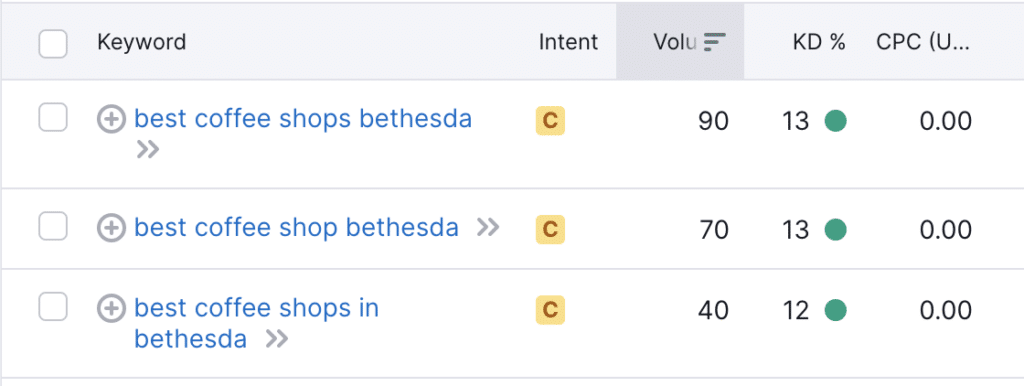
You’ll also want to find out whether the client’s site is already ranking on any existing keywords, as well as which keywords are being targeted by their competitors. This data can help inform your strategy by building on an existing foundation or filling in the gaps in SERPs.
Popular Keyword Research Tools to Try
If you’re ready to give SEO keyword research a shot or you want to strengthen your existing efforts, we’d recommend the following platforms:
- Ahrefs Webmaster Tools and Keyword Generator/Difficulty Checker
- Semrush Keyword Magic Tool
- Google Keyword Planner
- Google Trends
- Answer The Public
- Google SERPs (“Related Searches” and “People Also Ask”)
- Google Search Console
- Semify’s white label dashboard tools
Narrowing Down Your Keyword Selections
Once you’ve plugged in your seed keywords and made a more expansive list of possibilities, it’s time to narrow down your options. What’s tricky is that there isn’t only one way to choose the best SEO keywords. There’s no instruction manual that’ll point you to the exact terms you should be targeting. That means you have to become comfortable with making educated guesses.
Geraghty says, “Experimentation is a huge part of SEO keyword research, but it’s not an exact science. Although you can get really technical and add numbers to it, it’s sometimes more of an art. Everyone’s keyword research process is different. You’re making a hypothesis based on what you know about Google, what you’ve learned about your client, and all your previous experience as a marketer.”
Generally speaking, though, there are a few basic considerations to keep in mind as you research keywords for your client campaigns.
- Search volume: A keyword’s monthly search volume can indicate how popular the search query is. Broad keywords will typically have a higher search volume than long-tail keywords. That said, a keyword with a lower monthly search volume can still have a high conversion rate and will often be better aligned with a client’s budget and other goals. Unless your client has an unlimited budget to spend on SEO every month, you won’t want to target search terms with tens of thousands of monthly searches. Especially at the start of a campaign with a modest service plan, choose search terms with respectable-yet-realistic monthly search volumes that range somewhere in the low-to-mid-hundreds.
- Relevance: The keywords you target should directly relate to the client’s website, their products/services, their industry, and their customers. Rather than try to game the system with buzzy keywords that don’t fit the user’s needs, find keywords that accurately reflect the client’s brand and what they have to offer. Keep in mind that this can change over time, depending on seasonality or product focus; the keywords you choose to target during the campaign’s first six months may not be the same ones you highlight a year in.
- Search intent: Understanding user intent is a crucial component of keyword research and selection. For instance, we’re not trying to target the term “keyword generator” in this article. It has 3,600 monthly searches, so we know users are looking for it – but because it doesn’t fit with the content we’re offering here, it’s not going to satisfy what those users are seeking. That keyword has commercial intent, according to Semrush; our post is aiming to educate, rather than to immediately make a sale. The keywords you select for clients need to align with where their customers are in the funnel and your overall SEO strategy. Otherwise, you’ll bring in irrelevant traffic that won’t convert.
- Budget: Although SEO is more affordable than PPC, that doesn’t mean all SEO keywords are worth the same. Some keywords will be more expensive to rank on than others. It’ll require far more resources to rank number 1 on a broad term than to snag the third spot in the ranking for a long-tail keyword. In many cases, the second option will come with a higher ROI. Consider the client’s monthly SEO budget when selecting keywords to ensure they get the most bang for their buck.
- Competitiveness: You’ll want to consider both competitor analysis and overall keyword competition when determining your keyword SEO strategy. Identifying keyword gaps ignored by competitors can help get your client ranking, while going after overly competitive terms can waste their resources. Cost per click and keyword difficulty are two ways to figure out how competitive a keyword is; we also provide a keyword budget breakdown that expresses keyword competitiveness by assigning a dollar value to each keyword recommendation. When you understand keyword competitiveness, you can divvy up a client’s SEO budget more effectively.
Once you’ve used these considerations to narrow down your list, you’ll be left with some high-value keywords to recommend to your client.
What’s Included in Semify’s Keyword Research and Competitor Analysis Process?
Keyword research for SEO can be complex (and even intimidating!). There’s no one definitive tool that every expert uses to research keywords, and data can vary based on platform. Most marketers would agree that using a variety of keyword research tools – for inspiration, comparison, and ultimate selection – is the best way to go.
In the end, that means that keyword research can take up a lot of your valuable time. When you have an agency to run and grow, devoting several hours to SEO keyword research for each client may not be a viable option.
While keyword research for SEO is a necessary step in setting your clients up for success, that doesn’t mean that you have to be the one to execute it. As your white label SEO partner, we’re here to make your life easier while delivering better results for your customers.
Although some clients will provide a wishlist of keywords to target, Geraghty explains that most account managers will require keyword research to be performed before the campaign officially starts. Doing our due diligence from the beginning can help avoid frustration and confusion later on.
Our SEO keyword research process usually starts with competitor analysis, says Geraghty.
“I’ll request information on the client’s competitors from the reseller and perform some keyword research based on what those competitors are ranking on,” explains Geraghty. “Then, I’ll send that list to the reseller to make sure those terms make sense for the client and what they want to focus on. This is especially important for highly technical or more ‘niche’ industries. We’ll also chat about where the client’s business is currently growing and where they want to focus their efforts for the next six months or so.”
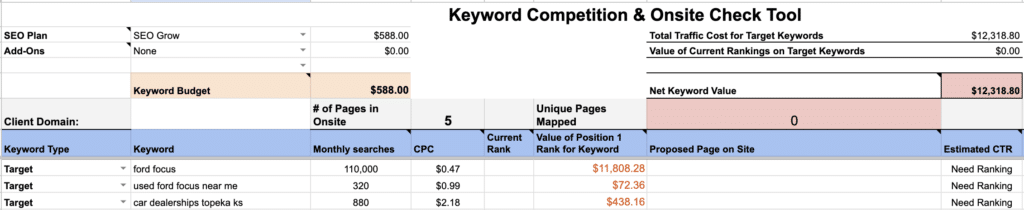
Once Geraghty confirms she’s on the right track, she’ll use Semify’s keyword research spreadsheet to determine the best keywords for the client’s service plan and budget. She’ll plug in her keyword recommendations, as well as data like the number of monthly searches and the keyword’s cost per click (as reported by Google Ads and Semrush), to show the value of those chosen keywords and how well they align with the client’s service plan and monthly budget.
As you can see from the example below, that car dealership client would easily go over his monthly budget by targeting “Ford Focus” with his site’s SEO. Choosing less competitive terms will help the client target the right audience without overspending. Although higher-tier plans allow for larger keyword budgets, that won’t automatically help the client rank on more competitive terms (especially if their site has a lower domain rating and isn’t currently showing up for much in SERPs).
Throughout the campaign, Geraghty monitors keyword rankings progress and other campaign metrics in real time (which are accessible to our partners within the “Research” and “SEO” sections of Semify’s white label dashboard) and recommends a keyword research refresh every six months.
What Are Some Common Misconceptions About How to Choose Keywords for SEO?
Knowing how to choose keywords for SEO isn’t always obvious. Making matters more complicated, there are some pervasive myths about keyword research and selection that can work against you (and your clients). Let’s dispel some of the most common misconceptions about how to perform keyword research and how to choose keywords for SEO to help you avoid these pitfalls.
1. What’s Popular Is Always Best
When it comes to search volume, it’s easy to get tunnel vision. After all, if a lot of web users are searching for a specific term, it has to be valuable… right?
It really depends on the situation – but in many cases, you shouldn’t get too caught up in monthly search numbers. Just because a keyword is incredibly popular doesn’t mean it’s a good choice for an SEO campaign, especially if your client runs a small business and has a limited marketing budget.
Broad keywords tend to have the highest search volumes. But as buyers make their way through their journey, queries start to become more refined. By the time they’re ready to purchase, users have narrowed their search from “shoes” to “cheap women’s Nike sneakers near me.” If you optimize for the former instead of the latter, you’ll miss out on the traffic that’s more likely to convert – and spend way too much trying to compete with global competitors.
Remember: Search volume doesn’t always align with search intent or your client’s key demographics. While the number of monthly searches matters (as you don’t want to target a term that has virtually zero traffic), be sure to weigh monthly search volume against other factors like intent and relevance to find the keywords that will actually serve your clients’ needs.
2. Don’t Narrow Your Reach
Some business owners are afraid that if they get specific with their keyword targeting, they’ll risk missing out on potential customers. But instead of trying to appeal to everyone within a 1,000-mile radius, it’s actually better to target the true service area.
Unless your client actually has a business location within a major city center or they’re located reasonably close by, trying to target a major metropolitan area the client doesn’t serve will hurt more than help. For one thing, it can keep them out of the map pack (which means they’ll have lower visibility in SERPs anyway!).
For another, it won’t help them reach their actual customers. Say you live in Frederick, Maryland and are looking for a dentist. You probably won’t even search for dental providers in Washington, D.C., an hour’s drive away. Instead, you’ll look for dentists nearby. Choosing accurate location-based keywords, even if they have a lower search volume, will be better for your clients in the end.
3. Keyword Research Is “One and Done”
Keyword research and competitor analysis are undoubtedly important. And because they can also be time-consuming, many business owners (and even some busy marketers!) may hope that it’s a one-time process.
Realistically, though, keyword research is never really finished. To help your clients reach new heights, you’ll have to evaluate what’s working and what could use improvement. Additionally, business owners will often shift their focus based on the seasons, produce or retire services and products, and adjust their budgets over time. That means you’ll need to monitor progress, make adjustments, and research new keyword options as needed. We recommend performing a keyword research refresh twice a year for this reason. Even if you stick with the majority of your existing keywords, this will make sure your bases are covered.
4. There’s No Difference Between SEO and PPC Keywords
It’s true that you can target (or bid on) the same keywords for both SEO and PPC campaigns. But should you? In a lot of cases, the answer is no. Even if you’re running simultaneous organic and paid search campaigns for the same client, you’ll likely want to choose different keywords for SEO vs. PPC. Some keywords (like very long-tail search terms or informational keywords) will be a better fit for organic results. Others (such as commercial or transactional keywords) will be better suited for paid search campaigns. In addition, some keywords may be too expensive for a PPC campaign but are a good fit for SEO. Consider the interplay between organic and paid search when selecting your keywords to give your clients the best chance of competing in SERPs. If you’re unsure of which keywords are better for SEO or PPC, your dedicated account manager can make personalized suggestions based on the client’s budget and overall goals.
5. SEO Keyword Research Should Be a Snap
While it shouldn’t take several weeks to perform keyword research for a client, it shouldn’t be a 10-minute process, either. You may have to immerse yourself in the client’s world, especially if they operate in a niche industry, they offer B2B services, or their offerings are highly technical.
It can take time to discover which keywords their customers are actually searching for, rather than relying on the business owner to provide you with technical, industry-level terms that only they use and understand. A dermatologist might say they specialize in helping patients with seborrheic dermatitis, but that won’t help people who want to find out how to treat dandruff.
It’s also easy to disregard context when you’re trying to perform keyword research too quickly. If you’re unfamiliar with the client’s products and you don’t take your time to delve into what they really offer, you might make keyword recommendations that are completely irrelevant to their business. We’ve seen overburdened agencies do things like optimizing a client site for specific keywords related to handheld digital devices (tablets) rather than the product they actually sold – medical supplements (tablets).
Although learning how to do keyword research for SEO will take time and effort, it’ll become easier when you do it more frequently. Still, it’s never going to be something you can complete during a brief break between meetings. If you simply don’t have the bandwidth to perform thorough keyword research, you may want to consider seeking out additional SEO support. That way, you can make better recommendations to your clients without taking on too much.
Can I Improve My Keyword SEO Strategy and Research Process?
You may know the answer to “why is keyword research important,” but how do you know whether you need to revamp your SEO keyword research process for your clients? Here are a few quick indicators that you might want to get some extra help from Semify:
- You can’t spend more than a few minutes on keyword research and selection for a client
- Your existing clients haven’t seen positive keyword movement in months
- Your clients have gotten more organic traffic, but their conversion rate is low
- Your client’s site has a high bounce rate with no obvious technical issues
- You’re optimizing only for the keyword list your clients themselves provided
- Your clients are directly competing against large corporations for keyword rankings
- You don’t feel confident in your ability to improve a client’s keyword selections
- You can’t figure out why your clients aren’t (or are!) ranking on a search term
- Your clients are threatening to leave due to a lack of results
Dealing with how to choose keywords for SEO can be tedious, confusing, and sometimes overwhelming. But it doesn’t have to be. We’re here to support you so that you can focus on running (and growing) your business. To learn more about joining our white label SEO reseller program, get in touch with us today.
Recent Posts