Are Web 2.0 Backlinks Good For SEO?
Sammi Cohen • 1 June 2022
Colorful social media icons connected by a spiderweb-like network on a light background

The fact you’re here means you already know that link-building is a crucial component of SEO. And that puts you ahead of the pack, considering that Ahrefs reports 66.31% of web pages have no backlinks at all. As a marketing expert, you may already be partnering with a white label SEO agency like Semify to ensure your clients consistently have backlinks built to their sites.


But not all backlinks are created equal. And the difference between a good backlink and a not-so-great backlink isn’t always crystal clear.


One of the most common questions we get from our clients – marketing agencies that need fulfillment support to scale their businesses – is about web 2.0 backlinks. Whether you choose to outsource SEO or build backlinks in-house, here’s what you need to know about web 2.0 backlinks and their potential impact on your strategy.


What Is Web 2.0?

Web 2.0 refers to the whole of the modern internet. (Talk about overwhelming!) Compared to “web 1.0,” when people talk about web 2.0, they’re describing a shift in how the internet is used. In the past, internet users were passive readers. Now, they’re active contributors. For example, social media platforms depend on independent users sharing information in order to function.


In a nutshell, you can think of this as the difference between an old-school encyclopedia website and the modern Wikipedia, where anyone can edit and change entries.


What Are Web 2.0 Backlinks?

In the context of SEO, “web 2.0” has morphed into shorthand for a specific type of backlink building. These are links that originate from content a user can control. To give yourself a web 2.0 backlink, all you need to do is create an account and publish a post or a comment with your link.


Some examples of web 2.0 backlinks sites include Blogger and WordPress blogs, Tumblr, Reddit, Quora, Goodreads, Medium, Wikipedia, Pinterest, YouTube, Twitter, Facebook, Vimeo, directory websites, and comments sections on articles.


What Are the Benefits of a Web 2.0 Backlink?

There are a few reasons to consider building backlinks on web 2.0 sites into your SEO strategy:

  • Domain rating: Established websites such as Facebook or WordPress likely have a higher domain rating than newer websites. Theoretically, a link in a comment on a blog with a 79 DR could help your SEO strategy a lot more than a random link from a new site with 15 DR.
  • Immediate publishing: Instead of having to perform tedious link outreach tasks, you can take the DIY route and post links without publisher approval or relationship building.
  • Free or low-cost: Marketers working with a limited budget may be interested in alternatives to strategies like creating guest posts or buying backlinks for SEO (which don’t always pay returns on your investment).
  • Search engine visibility: These backlinks will be indexed and crawled quickly, thanks to high user activity. Backlinks on these indexed pages are more valuable than links on sites that aren’t crawled regularly.
  • Link control: You have more control over anchor text and link context since you’re writing the content yourself. If you’re specifically trying to build your backlink profile to contain a certain type of anchor text (like branded anchor text, for example), you can more easily make that happen.

Are web 2.0 backlinks do-follow links?

This is the big catch when building web 2.0 links. All backlinks come in two primary categories: do-follow and no-follow links. Do-follow links are typically the more desirable option because they pass “link juice” from one website to another and can boost your site’s reputation. They’re the gold standard.


A no-follow link is neutral – it doesn’t necessarily endorse the website it links to, but it doesn’t say anything negative about it, either. No-follow links can be part of a healthy backlink profile, and they can still drive traffic to your site. That said, you don’t want no-follow links to make up the majority of your links because they’re missing that valuable endorsement.


The vast majority of web 2.0 links you add as a user of larger sites will default to no-follow. (Note: Twitter just removed the rel=nofollow attribute from its links. It’s unclear whether these links will count as do-follow links moving forward, but it’s something to watch!) If you’re publishing links on a site you own, however, you control whether a link is no-follow or do-follow. If you’re specifically looking for a few quick, low-cost backlinks and no-follow links aren’t a deal breaker, a quality web 2.0 backlinks site can feel like a reasonable option. But we’d still recommend you proceed with caution.

Avoiding toxic backlinks

Our friends at SEMRush explain that “toxic” backlinks can come in many forms on Reddit forums


rms. Generally, toxic links aim to manipulate a site’s ranking in SERPs or a site’s incoming or outgoing links. Toxic links frequently come from sites that have been established for the sole purpose of providing links, sites that haven’t been indexed by Google, and non-relevant sites and content.


One toxic backlink might not do irreparable harm to your SEO. But if a marketer hoping for a shortcut attempted to publish, say, 100 links from poor-quality or irrelevant sites just to boost SEO, Google is likely to see those spammy links as red flags. A spammy backlink profile could also be hit with Google penalties. These are fixable over time, but the work probably entails removing the offending backlinks in the process – meaning a lot of extra work and little or nothing to show for it.


You could avoid being spammy by taking the time to create or buy websites that publish great content. If that content is indexed by Google and actually becomes popular, you could end up with a successful site with a lot of valuable traffic. You’d have to pay for additional hosting and web design, keep up with content creation and marketing, and take on the additional responsibility of owning multiple sites to get a single backlink per site.


That long game sounds pretty labor-intensive to us. You’d likely get a better SEO strategy payoff putting that level of effort into pursuing link outreach instead.


Original Research: Semify’s Web 2.0 Backlink Experiment


There’s a lot of misinformation online about which (if any) web 2.0 opportunities provide do-follow links. We set out to field-test some shortcuts to see if they’re worth your time.

The hypothesis: Reddit do-follows links with more than three upvotes

We heard rumors that links on Reddit forums will change from no-follow to do-follow links if the comment or post is upvoted three or more times. (Check out the inline link there – we linked to this particular source with a no-follow link of our own.) Before we recommend hacks like these to our clients, we want to make sure they actually work.

So we tested it.

Test 1: Upvoting a low-volume comment

Here’s how we tested the three-upvote hack: On a local Reddit forum, we found a helpful comment containing links, which had 2 upvotes. We added our own upvote and monitored the comment for two weeks. The comment now has 6 upvotes (bringing it above the rumored 3-vote threshold), but we saw no change from the default do-follow HTML structure. Here’s what it looked like both before and after:

Tiny webpage screenshot with a red arrow pointing to a highlighted link in the top navigation bar.

Result: We debunked this rumor.

Test 2: Investigating a higher-volume comment

Maybe the three-vote rule doesn’t take effect immediately. The comment on that post might take time to get on Reddit’s radar, we figured. So we looked at a different Reddit comment with 58 upvotes. This comment had been in place for three weeks, which meant it might have had more time to accrue upvotes or for Reddit to “notice.”


Alas, this link contained the same no-follow link structure as our first test:

Tiny, blurry code snippet on a white background with colored text and a red arrow above it

Result: This rumor stayed debunked.

The hypothesis: Reddit adds do-follow attributes depending on a link’s “hotness”

Supposedly, a Reddit post needs to be trending (categorized as “rising” or “hot”) for at least 24 hours in order for any links to become do-follow. The poster’s Reddit “karma” may also be a factor in the algorithm, according to black hat SEO web forums. (Don’t worry, we’re not giving even a no-follow link to black hat forums!)


Test: Examining trending posts

Ideally, we’d examine a selection of trending posts that trend for 12, 24, and 48 hours to determine when the “do-follow trigger” kicks in. There’s no clear indicator of how long a post has been trending, so it’s difficult to find a post that’s been trending for each precise amount of time. We didn’t see the value in wasting hours and hours to validate a Reddit rumor that would be even harder to harness. (It’s not easy to purposefully manufacture a post that trends for at least half a day on such a highly trafficked forum!) Frankly, we don’t think this is worth your time, either.


So we tested one link on a post that was trending for at least seven hours after it was published, and it was still a no-follow. When we checked back a day later, the post had 11,000 upvotes and nearly 300 comments. However, the link to the Twitter post was still specified as no-follow.

Blurry browser code snippet with a red arrow pointing to the right end of the line.

Result: Three strikes and you’re out, Reddit rumor. Getting 11,000 upvotes on a Reddit post is no small feat, and we don’t think it’s worthwhile for marketers to spend that much effort on an unverified strategy. There are better ways to do SEO. Sure, Reddit has a DR of 95, but we don’t see a way for a marketing agency or most other businesses to reliably benefit from its link juice.

The hypothesis: Other web 2.0 opportunities might have do-follow links

Even if Reddit doesn’t have magical do-follow links that you can game by simply upvoting your comment a few times, we wanted to know whether other common web 2.0 sites do have better backlinking opportunities.

Test: Tumblr, Flickr, Quora

First, we looked at other UGC-heavy sites like Tumblr and Flickr. These employ a default link structure known as “noreferrer.”

Close-up of a code line with syntax highlighting and a red arrow pointing to a specific section.

If you get a noreferrer link, you won’t be able to track it. If people click on the link, you’ll simply see it in your analytics as direct site traffic. In other words, no one will know that Flickr or Tumblr is referring traffic to your site. You can think of it as no-follow to the nth degree.


Quora is even more impregnable. From what we could tell, Quora’s source code doesn’t contain the user-generated content displayed on the site at all. That means Google won’t see (much less follow) any links published there. There could be exceptions, but it doesn’t seem worth it for marketers to devote excessive time to finding them if they do exist.

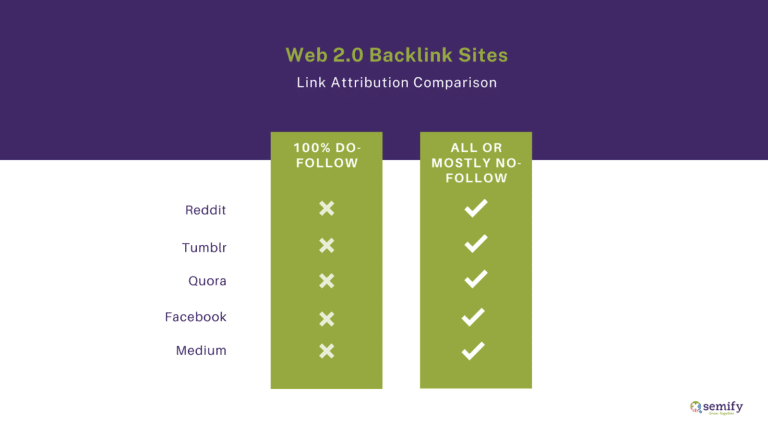
Infographic comparing Web 2.0 backlink sites: dofollow vs nofollow for Reddit, Tumblr, Quora, Facebook, Medium.

Result: We couldn’t find trustworthy reports of any of these sites providing do-follow links, nor could we verify them ourselves. That makes us confident that these backlinks aren’t going to make a major difference in a site’s SEO.


Semify’s Take: Web 2.0 Backlinks Aren’t Worth Your Time

Let’s assume that links you publish on Reddit, Quora, or Tumblr are no-follow or noreferrer links. That means there’s no major SEO benefit to these links except for fleshing out your backlink profile with some no-follow links. But if you’re developing a natural backlink profile and your brand is becoming more well-known, this should happen naturally over time regardless.


Google reps say that web 2.0 backlinks are often seen as spammy. According to Google Webmaster Trends Analyst John Mueller, relying on web forums or blogs to drive traffic for your brand isn’t exactly recommended.


“All of those examples… are really terrible ways of promoting your website,” Mueller explained during a 2020 Webmaster Office Hours Hangout. “This kind of activity has zero value for SEO. They’re spamming the web. That’s something I would strongly discourage anyone from doing.”


Keep in mind that Google won’t be the only one judging your backlinks. Redditors and users of websites like Tumblr, Quora, and WordPress domains will see your posts or comments and make their own determinations. If your posts are helpful and send traffic to your client’s website, then they could improve people’s perceptions. If you post links in a way that’s spammy or uninteresting, you’ll hurt the company’s reputation and users could downvote your content – which could hurt your strategy, anyway.


That’s not to say that all web 2.0 backlinks are harmful. But it’ll take work to create web 2.0 links that are genuinely helpful and interesting. If you’re going to put in the work, we think your time would be better spent focusing on natural or editorial backlinks instead.


Oh No! What if I’ve Already Started Web 2.0 Backlinking?

You probably don’t need to panic if you’ve already started. You may not have to remove any of these backlinks from your profile, either. If you’ve made a good-faith effort to use backlinks on posts where the links add value, a few web 2.0 backlinks probably won’t read as spammy.


Going forward, we’d just recommend you stick with link outreach and link-building through natural means that offer better value. And if you’re really worried, you can physically remove the UGC backlinks or disavow them through the Google Search Console.

Bottom Line

As a marketing professional, you know that offsite SEO is essential and link-building has a place in any client’s SEO strategy. But most of us don’t have extra time to waste. While web 2.0 backlink-building may seem like a shortcut, it could actually make the journey to SEO success a lot longer.


Really, there are no shortcuts in SEO. Although web 2.0 backlinks aren’t innately bad, they’re also not going to get you where you want to go.


The straighter, clearer path involves building relationships with publishers, creating highly valuable content, and working with a white label SEO agency that can expertly perform link outreach for your clients.

Recent Posts

Two smiling men posing indoors, one in a Semify jacket and one in a checkered shirt.
by Patrick Briggs 8 December 2025
Semify acquires Dragon Metrics to enhance global AI optimization capabilities and expand into international markets. Learn what this means for agency partners.
by Nicole Jarvey 4 September 2025
How to Outsource SEO in a Successful Way When you outsource SEO, it’s not that you are only physically losing control of your marketing, but that you have no way of knowing whether the same strategy is being put into place. Are you looking to boost your search rankings, attract better leads, or find new customers? Good objectives will also allow your SEO partner to develop a plan that reflects your vision. After you know what you need to accomplish, vet providers thoroughly. Your best bet is to find a reputable SEO agency, like Semify , that provides results, honest reporting, and good communication. We will provide a full range of services from keyword research and link building to technical audits and content optimization. We can help you choose the plan that aligns with your budget and stage of growth, whether you are a single business looking to scale or an agency handling multiple clients. When done right, outsourcing is a partnership where you continue to do what you do best, but let specialists, like us, handle the nitty-gritty of the technology behind getting measurable results. Should You Outsource SEO? The idea of in-house management of SEO sounds like a great thing until you realize how much work it really is. It’s not just about keeping an eye on what the competition is doing; you need to grow it and generate consistent content, or you can quickly be left behind. Many businesses find that in-house staff just don’t have the time or proficiency to manage it effectively. If you’ve ever felt at a loss for staying abreast of Google’s shifting algorithms, or if the responsibilities of SEO consistently end up at the bottom of your to-do list, then handing it over to us could be the best approach. Using Semify will allow you to open up time while leading the rest of the experts who know how to grow your business. The Benefits of Outsourcing SEO Outsourcing SEO gives you access to expertise, and that’s one of the most significant benefits of outsourcing with Semify. Instead of trial and error, you get a team that lives and breathes SEO and stays on top of algorithm updates and what’s new in the industry. This not only saves you from expensive mistakes but also expedites the results. Another key benefit is scalability. As your business or agency scales, though, your SEO needs will change. We can be flexible and scale up in terms of content production, link building, or technical support on short notice—whereas you’d typically have to spend time and money hiring (and possibly even training) new staff otherwise. The potential for cost savings also adds to the appeal of outsourcing. You have a salary and benefits, and perpetual training for your in-house people. In comparison, outsourcing affords you a complete team of professionals at a fraction of the expense. And because reputable carriers are transparent with information and have detailed reporting, you will always know the dashboard kind of view into how your campaigns are doing and where your dollars are going. In short, outsourcing SEO can save you time, give you more control over the costs, and, most importantly, drive better long-term results than in-house teams can routinely achieve on their own. Why You Should Consider Semify for Your SEO Services Not all SEO services are created equal, so who you choose to partner with matters. At Semify, we pride ourselves on being one of the most successful companies in providing white label SEO that has been proven through years of experience to help your agency unlock the potential of its online presence. There are a couple of reasons companies rely on us to do their SEO: We offer clear reporting, so you know where you stand at all times. Our approaches are rooted in long-term growth — not short-term, patch-the-holes measures. We see clients as partners, discovering what drives their business goals and sustained success — not just gaining short-term victories. Whether you are from an agency looking to expand services for multiple clients or are a single business that wants to increase visibility, we have a flexible and scalable plan for you. The Bottom Line So, should you outsource SEO? For a lot of businesses, the answer is yes. With the time and money-saving and expert strategy-building benefits it has to offer, outsourcing SEO is one of the soundest investments you can make for your growth. If you’re having to choose a provider, Semify is a partner you can trust. We bring together transparency, expertise, and scalable solutions whilst keeping it real and delivering tangible results. SEO Reseller Services - Call Semify today to outsource SEO.
by Nicole Jarvey 8 May 2025
Discover 19 proven, budget-friendly strategies to boost your website's domain authority and improve search rankings without spending a dime.
by Sammi Cohen 20 March 2024
A strong backlink profile is essential to ranking in Google. Learn what a backlink profile is, how to analyze yours, and how to improve it for better SEO.
by Sammi Cohen 18 March 2024
Semify has been honored with the RedHawk50 Award, recognizing our outstanding business growth and commitment to helping agencies scale with white label SEO.
by Sammi Cohen 23 February 2024
Explore the different types of backlinks and how each one impacts SEO . From editorial links to niche citations—learn what actually moves the needle.
by Sammi Cohen 14 February 2024
Last month, several Semifyers – including account managers, digital marketing specialists, and members of the sales and marketing team – traveled to Las Vegas to attend the Traffic and Conversion Summit. Known as one of the best marketing conferences for agencies and entrepreneurs, T&C focuses largely on AI-powered marketing, as well as the latest developments in paid traffic, influencer marketing, email marketing, ecommerce, local search, and more. We caught up with a few digital marketing conference attendees to find out what they saw as the biggest SEO predictions and trends from the Traffic and Conversion Summit that are likely to impact our work here at Semify, as well as how our partners can leverage this information to maximize growth in 2024. Here’s what they had to say about getting to the top of the marketing mountain. Artificial Intelligence Isn't a Passing Fad Because the Traffic and Conversion Summit is most notably billed as a digital marketing conference for AI-powered marketing, it’s no surprise that artificial intelligence was prominently featured in its programming. But that’s reflective of the state of marketing as a whole in 2024. In fact, as Semify Chief Revenue Officer Dave Thomson points out, AI is almost inescapable. “Everyone is jumping on the AI bandwagon, from AI-powered features to company branding,” says Thomson. “For example, chatbots are no longer chatbots; instead, they’re ‘AI support.’” Indeed, AI seems to be permeating virtually every corner of the marketing sector, as well as the workforce in general. Members of the operations team were eager to learn about other ways in which AI can be utilized, especially to speed up or completely eliminate mundane or complicated tasks. Semify Digital Marketing Specialist Cassia Kuhn says, “I was particularly impressed by the talks given by Roland Frasier, Ross Simmonds, and Adam Chronister, who demonstrated some interesting uses for AI. For example, instead of manually creating and formatting a spreadsheet, you can use AI to not only help you find the right formulas but also create the actual spreadsheet and format it in a way that’s easier to understand.” Kuhn notes that these uses have potentially big applications for an white label SEO agency like Semify: “These kinds of applications can allow us to put even more time into creating the high-quality content we’re known for.” Semify Digital Marketing Manager Shelby Toth echoes these sentiments. “From my perspective, one takeaway was quite clear: AI is coming. From blogs for websites to entire podcast-style videos, AI is making a huge impact in the marketing world,” says Toth. “Of course, I knew AI was growing even before attending the conference. While it’s a scary reality for many, it’s our duty to see it and embrace it fast or be left behind. I’ll be curious to see how AI content ranks against human-generated content in the coming year.” For our part, the growing emphasis on AI and how it’ll power digital marketing moving forward supports our current innovation efforts. While we as a team feel strongly that AI will never replace real, human experts, it’s an impressive supplemental tool that can help us and our clients reach new heights. Local Search Deserves More Strategic Attention AI received ample attention at this year’s Traffic and Conversion conference, but it wasn’t the only topic that got our wheels turning. Local search is getting its due, especially as the interplay between Google’s generative AI tool (SGE) and Google Business Profiles (GBP) will make a big difference in how we perform web searches in 2024 and beyond. As Google prioritizes fast, easy-to-digest answers, the search engine aims to keep web users on the SERP itself, rather than clicking away to independent websites. That presents a challenge for small business owners (and the marketing agencies that provide services for them) to increase visibility and traffic without requiring customers to click away from search results. Kelly Donald, Semify’s Director of Sales, says: “My biggest takeaway was that GBP activity and accuracy are crucial for local businesses and are a really amazing way for them to get in front of the traffic that they want to receive. Consistent activity makes a massive difference in visibility and 0 click searches are only likely to increase in the year ahead.” Thomson also recognized the need for better local search visibility for marketers at the Traffic and Conversion Summit. “I noticed a lot of attendees were smaller agencies and even brand owners with multiple locations,” explains Thomson. “The interest in how to better leverage the map pack and GBP in 2024 was definitely the topic du jour.”  Adds Toth, “Semify just recently launched our Map Pack product, which allows us to optimize end clients’ Google Business Profiles in a more effective way. It was great to hear session leader Norm Farrar reference things we’re already doing with this product, as well as areas we can focus on to improve it in future iterations.” While Google’s SGE has yet to be rolled out more widely, we suspect that it’s only a matter of time before it becomes the standard. As your white label SEO agency fulfillment partner, we’ll continue to stay ahead of the curve to provide your clients with new and better ways to drive traffic and conversions – even when Google tries to throw us off course. We're Ready For What's Next Above all, these 2024 SEO trends and predictions are telling us to stay on our toes and lean into what we already do well. Kuhn says, “My biggest takeaway from the Traffic and Conversion Summit is that, when it comes to SEO, Semify is unique. Our dashboard is one-of-a-kind, and so many attendees were surprised to see an entirely US-based team.” “My hope is that we can continue sending team members across all teams to the best marketing conferences so they can learn more and bring it back to their everyday work,” Toth adds. “It’s likely we’ll even develop new processes and products as a result. I’m eager to continue learning and growing so we can keep Semify on the cutting edge of SEO for years to come.” Semify’s Director of Marketing Innovation, Jeff Shipman, agrees. “Attending the Traffic and Conversion conference really solidified that we’re heading in the right direction,” says Shipman. “In order to develop an effective 2024 SEO strategy – and especially an enterprise SEO strategy for larger organizations – we have to embrace the latest developments without forgetting about what’s helped us get to this point. Innovating around tools like AI and Google Business Profiles, while staying true to our customer service-centric roots, is what will inspire mutual growth for both Semify and our partners.” To learn more about how our white label SEO reseller program can give your agency the fulfillment and innovation support you need, get in touch with our team today.
by Sammi Cohen 19 May 2023
Semify's small business survey reveals that 50% of SMBs aren't using SEO. Explore the data and what it means for agencies targeting local clients.
by Sammi Cohen 12 December 2022
In October 2022, we conducted our “Small Businesses and SEO” survey to learn more about the relationship between SMBs and search engine optimization. We’ve already shared some of our survey data related to the average cost of SEO per month, but there’s actually an even bigger takeaway: Over half of small businesses we surveyed either aren’t using SEO or aren’t sure whether SEO is part of their marketing strategy. As a marketer, you may find this hard to believe. After all, we feel the value of SEO is pretty clear. Not only is the ROI of SEO more substantial than other marketing channels, but it provides a cost-effective way to build trust with customers without relying solely on external platforms. Still, the numbers don’t lie. Let’s unpack the data and discover how you can turn these findings into growth opportunities for your own agency.
by Sammi Cohen 18 August 2022
Learn how paid and organic search strategies complement each other. Discover how to align SEO and PPC for better visibility and higher ROI.
Show More