


Are No Follow Links Important For SEO?
Sammi Cohen • 9 June 2022

Link-building is an important part of any client SEO strategy. After all, Moz data reveals that off-site SEO factors are likely to represent more than 50% of ranking factor weight. Therefore, any white label SEO agency will tell you that the work you do off-site matters just as much (if not more than) the on-site optimizations you’re making.


Building backlinks can be a great way to improve the domain rating of your client’s site. As we’ve learned, there are two main types of links you can build – follow and no-follow. We’ve broken down the basics of no follow vs follow links before, but we’re still haunted by a frequently asked question: Are no follow links useless for your SEO strategy?


Quick Refresher: No-Follow Links

Let’s quickly re-introduce the idea of link attributes. When a link is a do-follow, it passes along “link juice” from the referring domain. That means the first site gives a thumbs up to the second. Google will perceive the site being linked more favorably because the referring domain is willing to endorse it.


When a link contains a no-follow attribute, on the other hand, it’s essentially telling Google that the domain publishing that link does not endorse it. It’s not saying the link is bad, but it suggests that the referring site doesn’t want to give the link its seal of approval (for whatever reason). The no-follow link will theoretically not receive the “link juice” from the referring website in this scenario.


No-follow links can come from a wide variety of websites. Some sites (like many news outlets or large brands) treat all outgoing links as no-follow, while others will pick and choose which links they’ll provide a do-follow attribute to. For example, some websites might only provide do-follow links to educational resources, government agencies, or unbiased industry organizations. Another website might be happy to provide a do-follow link to a non-competitor with a great resource to share.


If you use a service like Ahrefs, you can determine which backlinks are no-follow by looking at your referring domains. You can also examine the source code of a given website to determine whether a link has a no-follow attribution in its URL structure. It’ll look like this:

Contrary to what some people believe, no-follow links aren’t bad. You’ll naturally find no-follow links in most backlink profiles, and they do serve a few important purposes.


Are No Follow Links Important For SEO?

We often hear from folks who ask, “are no follow links useless for my clients?” We’re inclined to answer no because:

  • No follow links can drive traffic to your client’s site
  • No follow links can assist in creating a more natural (less spammy) backlink profile
  • No follow links can keep a website from receiving a Google penalty
  • No follow links may still pass some sort of value from one domain to the other


Are they as valuable as do-follow links? Typically, no. But they usually won’t hurt your SEO when used in moderation. In some ways, they can help you by allowing you to avoid penalizations or to raise brand awareness and conversions.


But how much do no-follow links factor into how a website’s value is determined?


Semify’s Original Research: How No-Follow Links Impact Backlink Profiles and Overall SEO

Understanding the true impact of no-follow links is a huge undertaking – and it’s an area without much clarity. We wanted to perform some original research to see whether we could illuminate some truths about how much no-follow links impact SEO. (Spoiler alert: we now have more questions than answers.)


Looking Deeper Than DR

We started with some data we sourced directly from an Ahrefs post discussing how domain rating is calculated. In that article, we learned that three popular websites have something in common:

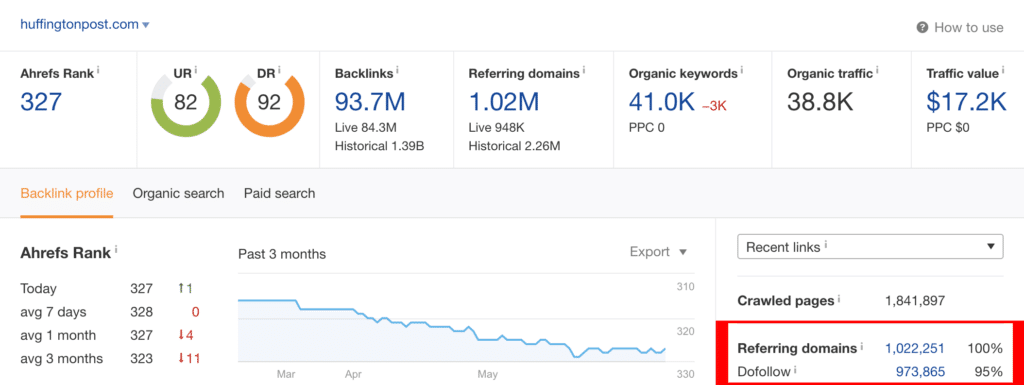
  • huffingtonpost.com = DR 92 (93.7 million backlinks)
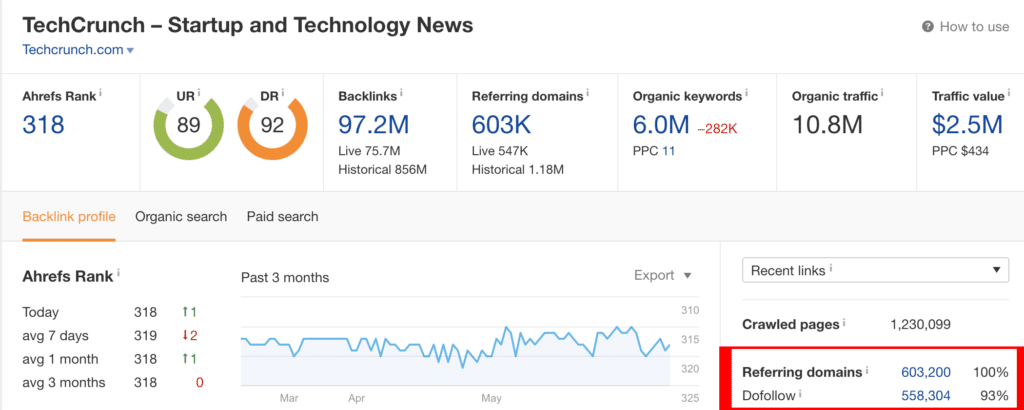
  • techcrunch.com = DR 92 (97 million backlinks)
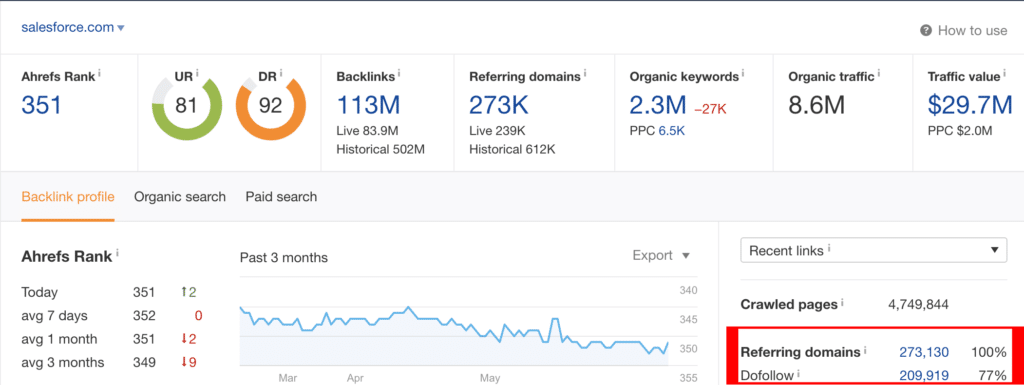
  • salesforce.com = DR 92 (113 million backlinks)


Yep, these very different websites all have the same domain rating. But DR doesn’t tell the full story. DR ranks a website on a scale from 0 to 100 based on the size and quality of its backlink profile; however, it doesn’t compare backlink profile strength relative to other websites.


According to data compiled by Ahrefs (using Ahrefs Rank, the platform’s ordering system based on backlink profile strength), HuffPost’s backlink profile is actually stronger – despite its lower number of referring backlinks – than those of both TechCrunch and Salesforce. HuffPost has an AR of 316, while TechCrunch comes in right behind at 317. Salesforce, conversely, has an AR of 346 and has the highest number of referring backlinks, suggesting that its link-building strategy may prioritize quantity over quality.


Do-Follow Links = A Stronger Backlink Profile (Despite Questionable Practices)

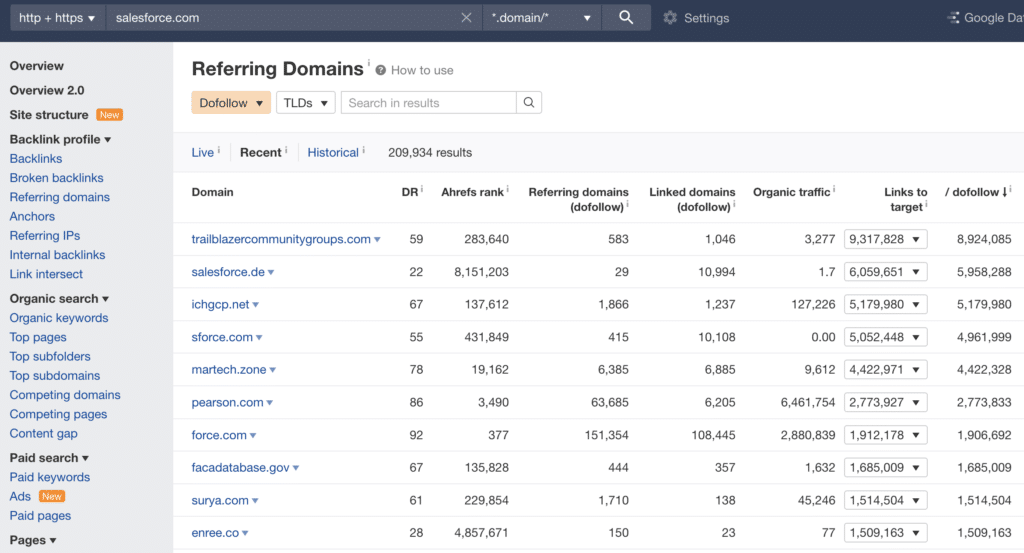
When we take a closer look at the backlink profiles for these websites, this assumption seems to ring true. Of Salesforce.com’s 273,130 referring domains, roughly 209,919 (or 77%) of them are do-follow links. TechCrunch , on the other hand, has 603,200 referring domains – 558,304 (or 93%) of which are do-follow. When we examined HuffPost’s referring domains, we found a similar ratio: out of 1,022,251 referring domains, 973,865 (or 95%) provided do-follow links.

Salesforce:

Huffington Post:

With this data in mind, it’s clear that having more do-follow links can often have a positive impact on domain rating and backlink profile strength. (No surprise there!) Having a higher percentage of do-follow referring domains correlates with a higher DR. Thus, we’d conclude that having a higher percentage of no-follow links in a site’s backlink profile won’t be quite as beneficial to its SEO (or at least this particular calculation).


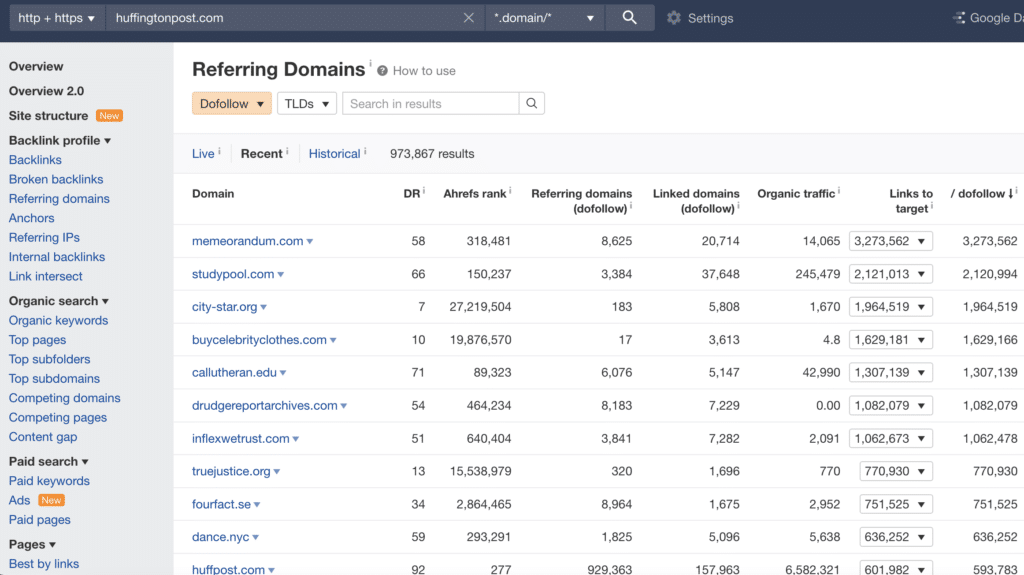
That said, things get interesting when you take a closer look at the referring domains. Here’s a peek at some of huffingtonpost.com’s most recent do-follow referring domains:

There are some sites with decent DRs listed, but all of those DRs are lower than that of HuffPost itself. There are also some low-DR websites there, like city-star.org, buycelebrityclothes.com, and truejustice.org. Despite two of those URLs having .org domain extensions, it seems Google doesn’t find them to be particularly valuable. What’s more, these referring domains run the gamut in terms of vertical (which may be expected, considering that HuffPost is a massive news outlet that covers a wide array of topics).


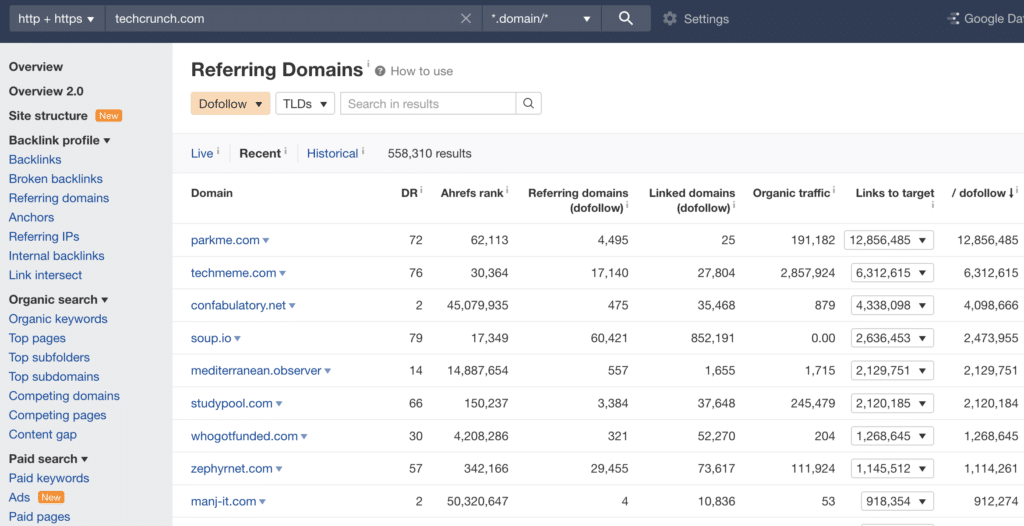
Now, let’s do the same thing for TechCrunch. Relevance aside, we’re seeing a similar pattern. There are a few DRs that are relatively high (though still less impressive than TechCrunch’s own DR), with some very low DRs mixed in. Again, these are all from do-follow links.

Another interesting thing to note is that the top-listed websites in these examples are pointing an unfathomably large number of links at our DR-92 examples. In the screenshot above, you’ll see that parkme.com (which essentially functions as a map directory website) has published 12,856,485 do-follow links that direct to TechCrunch. Even though TechCrunch may not be actively going after 12 million links from one domain, it’s not something we’d ever personally advise doing for SEO – and yet, it hasn’t seemed to hurt the site’s DR very much.


And what about the do-follow referring domains for Salesforce, the site with the weakest backlink profile? You might be inclined to think this site has a stronger profile if you were to use only the site’s recent referring do-follow domains as a reference point:

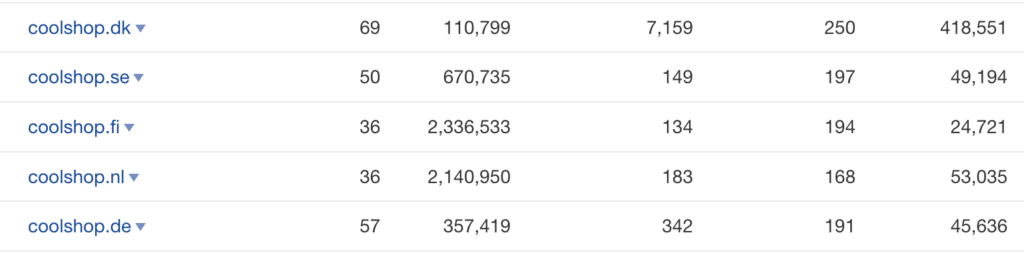
Generally speaking, this short list of DRs seems more impressive than the other two. The DRs are higher, at least. But as we continued to scroll down the list, we did find some very low-DR websites, as well. Many of the referring domains seem to be based outside of the U.S., with several URLs containing similar structures, as seen here:

When you consider only DR, having thousands of links coming from salesforce.de or these coolshop sites may seem like they’re better than the top referring websites for HuffPost and TechCrunch. But domain rating doesn’t paint the whole picture – and there’s more than one way to succeed at SEO.


Additionally, it’s tough to view these do-follow links in a vacuum. How do we know how Google weighs one link over another? Does Google care that these sites receive thousands of do-follow links from websites that aren’t particularly relevant or valuable? And even if Google does care, are those thousands of links being offset by other, better links somewhere in the site’s backlink profile? It’s nearly impossible to tell for websites that are this established.


No-Follow Links = No Clear-Cut Answer on Significance

But for the sake of argument, let’s look at the domains that are providing no-follow links to these sites. We expected to see some low-quality, spammy websites here. For example, even though it has a relatively high domain rating of 79, soup.io is clearly a private blog network. (Interestingly, TechCrunch has both do-follow and no-follow links from this site in its backlink profile.)

PBNs are controversial because they can serve a purpose (i.e., passing link juice), but they can also be lacking in organic traffic and overall content value if they’re poorly maintained. It’s possible that this site is scraping TechCrunch’s content and reposting it independently. Again, it’s hard to believe that TechCrunch would be purposely going after over 2 million links from one website – no-follow or not.


TechCrunch does have a couple of good referring domains in the no-follow section of its backlink profile, including several Yahoo! URLs, socialmediatoday.com, Business Insider Australia, and Search Engine Land. Again, these sites reportedly don’t pass any link juice – but it’s possible that having them included might provide some sense of legitimacy (or diversity, if nothing else). But if those links truly aren’t being followed, it’s unclear whether they add much meaningful value.


As you can imagine, our heads were spinning at this point. What does it all mean? Other than helping you create a more natural-looking backlink profile and potentially driving some traffic to your site, are no-follow links worth getting? Can they actually help your SEO in a way that’s significant enough to warrant a place in your link-building strategy?


What Other Experts Say About No-Follow Links

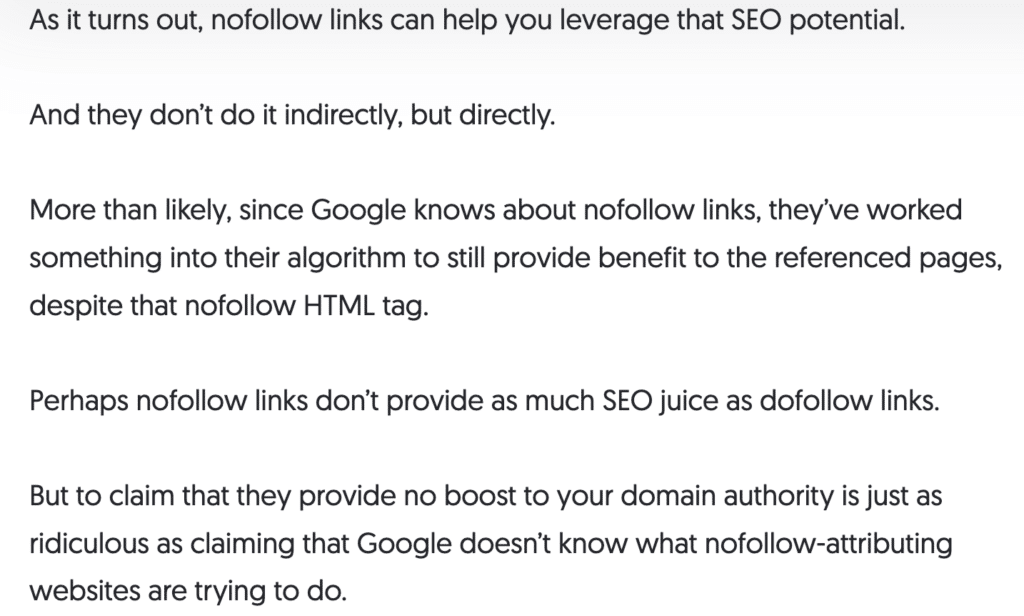
We decided to see what others in the industry have to say on this subject. Neil Patel boldly claims that Google has likely incorporated no-follow links into its algorithm in some way, meaning that no-follows almost certainly have an impact on SEO:

And here’s what Search Engine Journal reported when Google amended how it counts no-follow links back in 2019:


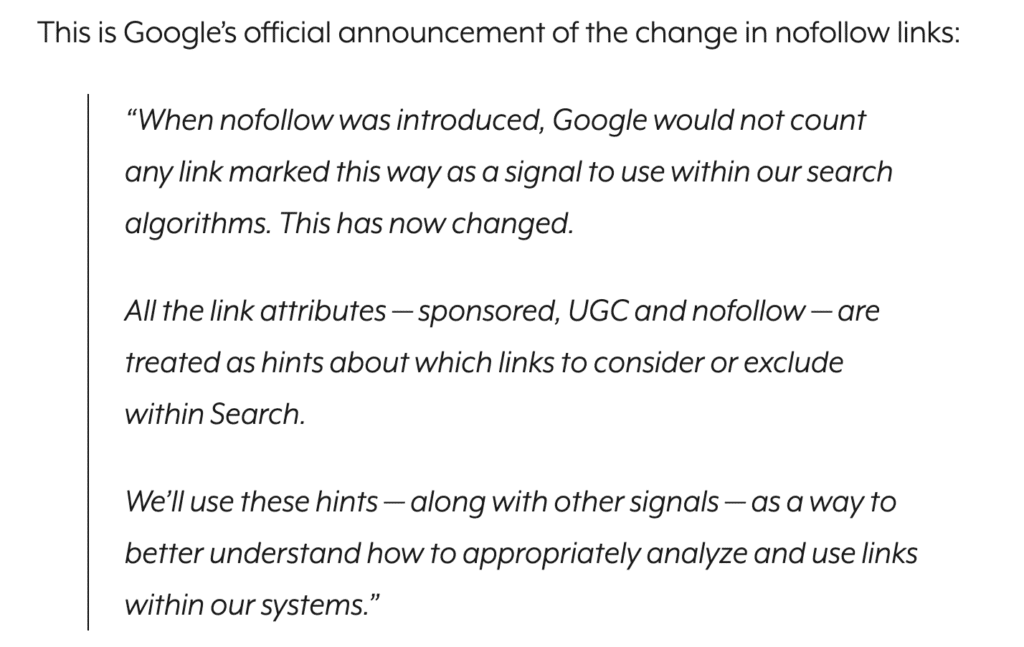
“Previously nofollow links were treated as a directive, meaning Google obeyed the nofollow, period. Starting today, for ranking purposes, Google is treating nofollow as a hint. This means that Google will decide whether to use the link for ranking purposes or not. This change impacts on-page SEO, content marketing, link building and link spam.”

Google, vague as ever, seems to answer the “are no follow links important?” question with an infuriating “it depends.” But what we do know is that there’s no longer a strict policy that keeps Google bots from following no-follow links. Now, there’s a chance (no matter how slim) that these links will still “count” towards how your site is ranked. The directive is now merely a suggestion, rather than a steadfast rule.


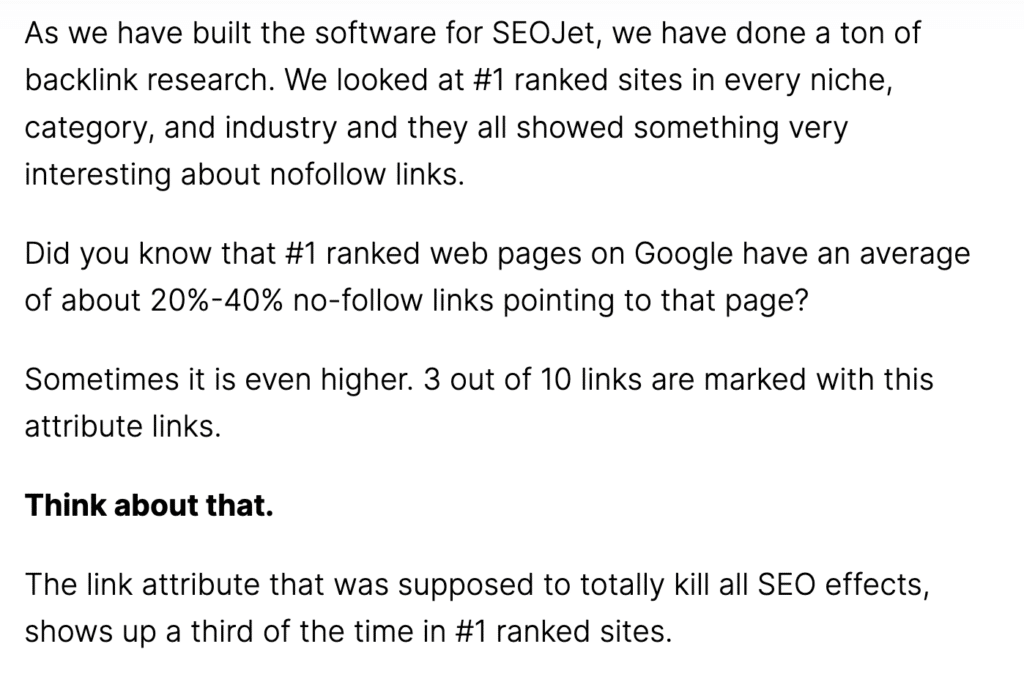
Finally, Semrush published some original research that suggests high-ranking websites have ample no-follow links pointing to them:

According to their data, about 20% to 40% of the backlinks pointing to #1-ranked sites in SERPs are no-follow links. Clearly, no-follow links aren’t hurting the SEO of these sites. These links are arguably necessary; the question is how big of an impact they might have.


When we analyzed the backlink profiles of those three well-known sites, it seemed obvious to us that having more do-follow links resulted in a stronger backlink profile. But are no follow links useless? We’d say no! Although we weren’t able to discern whether a specific no-follow link from a reputable, high-DR website has a measurable impact on a site’s ranking factors, general wisdom tells us that you’ll still want some to appear in your backlink profile.


Keep in mind that a site’s ability to pass link juice value actually depends on how many domains that site links out to with do-follow links. Even if you get a do-follow link from a high-DR site, the effects on your own DR will be diminished if that site provides do-follow links to just about anyone who asks. While that do-follow link probably won’t hurt, it also won’t make your DR jump a significant amount. In some cases, it may not be that much more beneficial to get a do-follow link than a no-follow link from a national news outlet – so even if the site isn’t officially endorsing yours, don’t panic! As with any SEO topic, multiple factors are considered here.


A Final Word on No-Follow Links

Ultimately, we can’t go so far as to say that no-follow links will definitely improve a site’s ranking. But we also can’t claim that no-follow links have zero effect on SEO. Even if a link is not technically followed (or “counted” in the eyes of Google), it can still improve your backlink profile’s organic perception and drive traffic to your site. In order to reap those benefits, however, you’ll want your no-follow links to be from reputable, relevant sites that have a tangible readership.


Should you turn down a no-follow link opportunity? If it’s from a website with a low DR that’s irrelevant to your niche, or if you already have a lot of no-follow links in your backlink profile, you’d probably be better off skipping it and trying to get a do-follow elsewhere. But if the site is relevant, has good traffic and a decent DR, and doesn’t require you to pay or spend lots of time on content creation, you might consider it if your backlink profile lacks no-follow links. Whether or not link juice comes into play, you could still boost sales or brand awareness if your audiences overlap.


Our takeaway: No-follow links can be useful, but they shouldn’t be the main focus of your link-building strategy. As with countless other digital marketing topics, there’s nuance and balance needed. Before you dismiss a potential backlinking opportunity just because of its attribute, work with your white label SEO agency to look beyond the no-follow and assess whether it could help (or hurt) your clients in other ways.

Recent Posts

Two smiling men posing indoors, one in a Semify jacket and one in a checkered shirt.
by Patrick Briggs 8 December 2025
Semify acquires Dragon Metrics to enhance global AI optimization capabilities and expand into international markets. Learn what this means for agency partners.
by Nicole Jarvey 4 September 2025
How to Outsource SEO in a Successful Way When you outsource SEO, it’s not that you are only physically losing control of your marketing, but that you have no way of knowing whether the same strategy is being put into place. Are you looking to boost your search rankings, attract better leads, or find new customers? Good objectives will also allow your SEO partner to develop a plan that reflects your vision. After you know what you need to accomplish, vet providers thoroughly. Your best bet is to find a reputable SEO agency, like Semify , that provides results, honest reporting, and good communication. We will provide a full range of services from keyword research and link building to technical audits and content optimization. We can help you choose the plan that aligns with your budget and stage of growth, whether you are a single business looking to scale or an agency handling multiple clients. When done right, outsourcing is a partnership where you continue to do what you do best, but let specialists, like us, handle the nitty-gritty of the technology behind getting measurable results. Should You Outsource SEO? The idea of in-house management of SEO sounds like a great thing until you realize how much work it really is. It’s not just about keeping an eye on what the competition is doing; you need to grow it and generate consistent content, or you can quickly be left behind. Many businesses find that in-house staff just don’t have the time or proficiency to manage it effectively. If you’ve ever felt at a loss for staying abreast of Google’s shifting algorithms, or if the responsibilities of SEO consistently end up at the bottom of your to-do list, then handing it over to us could be the best approach. Using Semify will allow you to open up time while leading the rest of the experts who know how to grow your business. The Benefits of Outsourcing SEO Outsourcing SEO gives you access to expertise, and that’s one of the most significant benefits of outsourcing with Semify. Instead of trial and error, you get a team that lives and breathes SEO and stays on top of algorithm updates and what’s new in the industry. This not only saves you from expensive mistakes but also expedites the results. Another key benefit is scalability. As your business or agency scales, though, your SEO needs will change. We can be flexible and scale up in terms of content production, link building, or technical support on short notice—whereas you’d typically have to spend time and money hiring (and possibly even training) new staff otherwise. The potential for cost savings also adds to the appeal of outsourcing. You have a salary and benefits, and perpetual training for your in-house people. In comparison, outsourcing affords you a complete team of professionals at a fraction of the expense. And because reputable carriers are transparent with information and have detailed reporting, you will always know the dashboard kind of view into how your campaigns are doing and where your dollars are going. In short, outsourcing SEO can save you time, give you more control over the costs, and, most importantly, drive better long-term results than in-house teams can routinely achieve on their own. Why You Should Consider Semify for Your SEO Services Not all SEO services are created equal, so who you choose to partner with matters. At Semify, we pride ourselves on being one of the most successful companies in providing white label SEO that has been proven through years of experience to help your agency unlock the potential of its online presence. There are a couple of reasons companies rely on us to do their SEO: We offer clear reporting, so you know where you stand at all times. Our approaches are rooted in long-term growth — not short-term, patch-the-holes measures. We see clients as partners, discovering what drives their business goals and sustained success — not just gaining short-term victories. Whether you are from an agency looking to expand services for multiple clients or are a single business that wants to increase visibility, we have a flexible and scalable plan for you. The Bottom Line So, should you outsource SEO? For a lot of businesses, the answer is yes. With the time and money-saving and expert strategy-building benefits it has to offer, outsourcing SEO is one of the soundest investments you can make for your growth. If you’re having to choose a provider, Semify is a partner you can trust. We bring together transparency, expertise, and scalable solutions whilst keeping it real and delivering tangible results. SEO Reseller Services - Call Semify today to outsource SEO.
by Nicole Jarvey 8 May 2025
Discover 19 proven, budget-friendly strategies to boost your website's domain authority and improve search rankings without spending a dime.

by Sammi Cohen 20 March 2024
A strong backlink profile is essential to ranking in Google. Learn what a backlink profile is, how to analyze yours, and how to improve it for better SEO.
by Sammi Cohen 18 March 2024
Semify has been honored with the RedHawk50 Award, recognizing our outstanding business growth and commitment to helping agencies scale with white label SEO.

by Sammi Cohen 23 February 2024
Explore the different types of backlinks and how each one impacts SEO . From editorial links to niche citations—learn what actually moves the needle.

by Sammi Cohen 14 February 2024
Last month, several Semifyers – including account managers, digital marketing specialists, and members of the sales and marketing team – traveled to Las Vegas to attend the Traffic and Conversion Summit. Known as one of the best marketing conferences for agencies and entrepreneurs, T&C focuses largely on AI-powered marketing, as well as the latest developments in paid traffic, influencer marketing, email marketing, ecommerce, local search, and more. We caught up with a few digital marketing conference attendees to find out what they saw as the biggest SEO predictions and trends from the Traffic and Conversion Summit that are likely to impact our work here at Semify, as well as how our partners can leverage this information to maximize growth in 2024. Here’s what they had to say about getting to the top of the marketing mountain. Artificial Intelligence Isn't a Passing Fad Because the Traffic and Conversion Summit is most notably billed as a digital marketing conference for AI-powered marketing, it’s no surprise that artificial intelligence was prominently featured in its programming. But that’s reflective of the state of marketing as a whole in 2024. In fact, as Semify Chief Revenue Officer Dave Thomson points out, AI is almost inescapable. “Everyone is jumping on the AI bandwagon, from AI-powered features to company branding,” says Thomson. “For example, chatbots are no longer chatbots; instead, they’re ‘AI support.’” Indeed, AI seems to be permeating virtually every corner of the marketing sector, as well as the workforce in general. Members of the operations team were eager to learn about other ways in which AI can be utilized, especially to speed up or completely eliminate mundane or complicated tasks. Semify Digital Marketing Specialist Cassia Kuhn says, “I was particularly impressed by the talks given by Roland Frasier, Ross Simmonds, and Adam Chronister, who demonstrated some interesting uses for AI. For example, instead of manually creating and formatting a spreadsheet, you can use AI to not only help you find the right formulas but also create the actual spreadsheet and format it in a way that’s easier to understand.” Kuhn notes that these uses have potentially big applications for an white label SEO agency like Semify: “These kinds of applications can allow us to put even more time into creating the high-quality content we’re known for.” Semify Digital Marketing Manager Shelby Toth echoes these sentiments. “From my perspective, one takeaway was quite clear: AI is coming. From blogs for websites to entire podcast-style videos, AI is making a huge impact in the marketing world,” says Toth. “Of course, I knew AI was growing even before attending the conference. While it’s a scary reality for many, it’s our duty to see it and embrace it fast or be left behind. I’ll be curious to see how AI content ranks against human-generated content in the coming year.” For our part, the growing emphasis on AI and how it’ll power digital marketing moving forward supports our current innovation efforts. While we as a team feel strongly that AI will never replace real, human experts, it’s an impressive supplemental tool that can help us and our clients reach new heights. Local Search Deserves More Strategic Attention AI received ample attention at this year’s Traffic and Conversion conference, but it wasn’t the only topic that got our wheels turning. Local search is getting its due, especially as the interplay between Google’s generative AI tool (SGE) and Google Business Profiles (GBP) will make a big difference in how we perform web searches in 2024 and beyond. As Google prioritizes fast, easy-to-digest answers, the search engine aims to keep web users on the SERP itself, rather than clicking away to independent websites. That presents a challenge for small business owners (and the marketing agencies that provide services for them) to increase visibility and traffic without requiring customers to click away from search results. Kelly Donald, Semify’s Director of Sales, says: “My biggest takeaway was that GBP activity and accuracy are crucial for local businesses and are a really amazing way for them to get in front of the traffic that they want to receive. Consistent activity makes a massive difference in visibility and 0 click searches are only likely to increase in the year ahead.” Thomson also recognized the need for better local search visibility for marketers at the Traffic and Conversion Summit. “I noticed a lot of attendees were smaller agencies and even brand owners with multiple locations,” explains Thomson. “The interest in how to better leverage the map pack and GBP in 2024 was definitely the topic du jour.”  Adds Toth, “Semify just recently launched our Map Pack product, which allows us to optimize end clients’ Google Business Profiles in a more effective way. It was great to hear session leader Norm Farrar reference things we’re already doing with this product, as well as areas we can focus on to improve it in future iterations.” While Google’s SGE has yet to be rolled out more widely, we suspect that it’s only a matter of time before it becomes the standard. As your white label SEO agency fulfillment partner, we’ll continue to stay ahead of the curve to provide your clients with new and better ways to drive traffic and conversions – even when Google tries to throw us off course. We're Ready For What's Next Above all, these 2024 SEO trends and predictions are telling us to stay on our toes and lean into what we already do well. Kuhn says, “My biggest takeaway from the Traffic and Conversion Summit is that, when it comes to SEO, Semify is unique. Our dashboard is one-of-a-kind, and so many attendees were surprised to see an entirely US-based team.” “My hope is that we can continue sending team members across all teams to the best marketing conferences so they can learn more and bring it back to their everyday work,” Toth adds. “It’s likely we’ll even develop new processes and products as a result. I’m eager to continue learning and growing so we can keep Semify on the cutting edge of SEO for years to come.” Semify’s Director of Marketing Innovation, Jeff Shipman, agrees. “Attending the Traffic and Conversion conference really solidified that we’re heading in the right direction,” says Shipman. “In order to develop an effective 2024 SEO strategy – and especially an enterprise SEO strategy for larger organizations – we have to embrace the latest developments without forgetting about what’s helped us get to this point. Innovating around tools like AI and Google Business Profiles, while staying true to our customer service-centric roots, is what will inspire mutual growth for both Semify and our partners.” To learn more about how our white label SEO reseller program can give your agency the fulfillment and innovation support you need, get in touch with our team today.
by Sammi Cohen 19 May 2023
Semify's small business survey reveals that 50% of SMBs aren't using SEO. Explore the data and what it means for agencies targeting local clients.

by Sammi Cohen 12 December 2022
In October 2022, we conducted our “Small Businesses and SEO” survey to learn more about the relationship between SMBs and search engine optimization. We’ve already shared some of our survey data related to the average cost of SEO per month, but there’s actually an even bigger takeaway: Over half of small businesses we surveyed either aren’t using SEO or aren’t sure whether SEO is part of their marketing strategy. As a marketer, you may find this hard to believe. After all, we feel the value of SEO is pretty clear. Not only is the ROI of SEO more substantial than other marketing channels, but it provides a cost-effective way to build trust with customers without relying solely on external platforms. Still, the numbers don’t lie. Let’s unpack the data and discover how you can turn these findings into growth opportunities for your own agency.
by Sammi Cohen 18 August 2022
Learn how paid and organic search strategies complement each other. Discover how to align SEO and PPC for better visibility and higher ROI.
Show More