SEMIFY GROW. TOGETHER.
If you’ve built your business from the ground up, it’s hard to be objective about your brand. But if you want to improve, you’ve got to learn how to take criticism in stride. And when an employee takes you to task, you’ll want to respond in a way that protects your reputation.
While this feedback might feel more like an attack at first, it’s actually a priceless gift to your organization. Knowing how to respond to Glassdoor reviews will help you make necessary improvements, attract top talent, and avoid a PR nightmare.
Let’s take a closer look at how to leverage Glassdoor reviews to your advantage.

What is Glassdoor?
Glassdoor is primarily an online review platform with a twist: instead of featuring reviews from customers, your company’s profile includes honest feedback from real employees. According to Glassdoor, the site “allows employees to provide ratings and feedback for career opportunities, learning and development, senior management, compensation and benefits, and company culture.”
Not only can Glassdoor reviews help job-seekers who are looking for new employment opportunities, but they can also guide business owners to make better branding and hiring decisions. Recruiters can also use Glassdoor to gain insight into the companies with which they work and improve on their processes moving forward.
If you’ve never used the site or mobile app before, you can essentially look up any business to instantly find out what their employees really think of them. And yes, that includes your business.
Does that thought make you nervous? Or would you be eager to receive constructive feedback from former and current staff members? Your initial reaction might say a lot about your brand – and so will how you publicly respond to these reviews.
But before we get into that, let’s talk about why these reviews even matter.
How Important Are Glassdoor Reviews?
The short answer is: pretty darn important.
With more than 32 million unique monthly visitors using the Glassdoor site and app in 2017, this platform had already become immensely popular before the pandemic. But Glassdoor reports that they now have 55 million unique monthly visitors. And with over 100 million reviews, salaries, and insights listed on the platform, it’s easy to understand why so many are using it to obtain trustworthy data about employers all across the globe.
Ultimately, it’s one of the quickest ways to get an accurate sense of what it’s like to work at a company. If you’re actively hiring, that’s going to matter a lot to candidates. But even if you’re not looking to fill any open positions right now, your Glassdoor profile can carry a lot of weight.
That’s because it isn’t just job-seekers who are using Glassdoor. Customers are also readily checking these profiles to find out whether they want to support certain companies or work with them on an ongoing basis. In another recent blog post, we outlined the importance of online reviews from customers. We trust online reviews just as much as (or sometimes more than!) personal recommendations from people we know.
With Glassdoor, you’re getting insider knowledge that goes beyond a one-time customer interaction; you’re learning about how companies treat their employees, which can give you a greater sense of a brand’s values and whether they align with your own. Among those surveyed by Glassdoor, the majority of users on this platform read at least 7 reviews before forming an opinion of a company. And while 89% of Glassdoor users are actively seeking a new job or would consider better opportunities, others will use the platform to monitor brands they have an interest in on a consumer or vendor level.
In other words, you have a huge opportunity to win over job candidates, clients, partners, and even members of your community with your Glassdoor reviews. On the other hand, a poorly managed Glassdoor profile can be the final nail in your brand’s coffin.
The Drawbacks of Glassdoor Reviews
Glassdoor has found a way to provide some much-desired transparency for job-seekers. That said, it’s sometimes appropriate for readers to take Glassdoor reviews with a grain of salt.
For one thing, these reviews are essentially published using the honor system. The platform doesn’t take action to verify that a reviewer was or is employed by a certain company, nor is there anything that stops users from posting multiple reviews for the same company. This could unfairly skew a company’s perception in a positive or negative way. A wronged employee could plague the company with unfair negative reviews, while an employer could theoretically spam their own account with unwarranted positive ones.
Glassdoor reviews are anonymous, which can be helpful in preventing employee retaliation and can promote honest and empowered feedback. But it also has the potential to be abused. And as with any other review system, people are more likely to leave reviews when they’ve had a negative experience. This means companies need to be proactive about encouraging reviews from employees in a way that still shows integrity.
Unfortunately, some companies will reportedly force current employees to leave a positive review (sometimes during the beginning stages of their employment) in an effort to counteract negative feedback or inflate their overall perception on the platform. We all know this is a shady move, but there’s not much that can be done to stop it.
However, we can take some solace in the fact that job seekers and leads alike will probably smell a rat. Suspicions start to arise when a company has only 1-star and 5-star reviews from employees with drastically different experiences that come in around the same timeframe. Unlike a singular customer experience, which can often vary quite a bit during a set period, that’s a far less likely scenario for employees who interact with the inner workings of a company on a daily basis.
It’s also worth noting that companies can change a lot over time. At Semify, we’ve recently undergone major changes in our culture and our infrastructure. While Glassdoor allows employees to leave reviews for up to 5 years after their employment has ended, a review from even a year or two ago might not accurately reflect the current experience someone might have with your business.
The drawbacks of this particular platform can feel discouraging. But knowing what they are can actually strengthen your brand’s approach to reputation management. When you understand the limitations of Glassdoor how to respond to negative reviews won’t be such a difficult question to answer. You’ll be better equipped to face those challenges head-on and in a way that puts a positive light on your company.
What Do Job Seekers Look For in Glassdoor Reviews?
If you’re wondering how to respond to Glassdoor reviews, your first step should involve gaining a clear understanding of what job seekers want to read.
It’s not enough to respond to potential criticism; you’ll also want to highlight the positives of your company that prospective employees care about. That’s a good strategy for when you receive positive feedback, as well!
But before we talk about your response to reviews, let’s go over the parts of initial employee reviews that job seekers want to see most often.
According to Glassdoor data, here are the highlights that show up frequently in reviews that candidates find to be useful in evaluating opportunities.
Remote Work Options
Even before the pandemic, job-seekers really liked the thought of flexible work arrangements. But now, remote work may be non-negotiable for many prospective employees. Glassdoor data suggests that 86% of employees would prefer to keep working from home on at least a part-time basis after offices reopen. Reviews that mention ongoing remote work can attract applicants, while reviews that allude to a full-time office work requirement could hurt your brand.
Employee Safety
Candidates want to work for companies that care about their well-being. Glassdoor reports that 70% of employees feel COVID-19 vaccinations should be required before returning to the office, and nearly the same percentage also say that employers should offer worker incentives to encourage vaccinations. Between March 2020 and February 2021, 58,000+ published Glassdoor reviews mentioned keywords related to COVID-19 and its vaccine – so the pandemic is clearly at the forefront of employees’ minds.
Glassdoor also found that anywhere from 38% to 79% of employees expect their companies to take steps related to provision of hand sanitizer, mask-wearing policies, properly spaced-out workstations, and employee temperature checks. Employers that fail to follow health guidelines will often be passed over for companies that are actively taking steps to keep their staff safe.
Diversity and Inclusion
Job seekers want to see themselves represented in your company. According to Glassdoor, 76% of current employees and job seekers say that having a diverse workforce is an important factor when evaluating job offers and employers. This is especially true for those within the Black, Hispanic, and LGBTQ+ communities.
Nearly 1 in 3 job seekers say they wouldn’t even apply for a job with a company that has a lack of diversity among its workforce. Moreover, 66% of employees and job seekers will trust a company’s workers regarding the real story of workforce diversity and inclusion over senior leaders, recruiters, or a company’s website.
Healthy Work-Life Balance
Are your claims of work-life balance actually backed up by the employee experience? Roughly 45% of employees say they now work more hours than they did prior to the pandemic, thanks to the blending of personal and professional life. Understandably, 41% of workers feel burned out, while 45% feel emotionally drained due to their work.
Glassdoor recently put together a list of the top companies and industries that prioritize work-life balance for employees. But even if your brand isn’t included, you’ll want to make sure that your policies regarding workload, paid time off, mental health services, and more truly prioritize the well-being of your employees. Your reviews will probably be a good gauge of how effective those policies are.
Employee Engagement
Employee satisfaction is one of the biggest indicators of a good employer on Glassdoor. Glassdoor claims that boosting employee satisfaction by one Glassdoor rating point increases the market value of a company by 7.9%! Of course, there are a lot of factors that go into employee satisfaction, including leadership, culture and values, career advancement opportunities, work-life balance, compensation, and more.
Different employees may feel motivated by different factors, but overall engagement and satisfaction can tell you a lot about whether you want to work with or for a company. If a worker actually likes their job, they feel valued, and they feel they’re receiving the guidance and support they need, they’re likely to stay a lot longer. Conversely, if you’re seeing a lot about high rates of turnover in a company’s reviews, you can probably assume that employee engagement is low.
Compensation and Advancement Opportunities
It shouldn’t take a genius to figure out that employers need to 1) pay a living wage and 2) provide opportunities for employees to advance their careers. If you fail to address either one of these issues, you’re bound to have a lot of turnover – plain and simple.
We’re starting to see the effects of the “Great Resignation” and many employers are currently in a hiring crunch, unable to find the candidates they need to fill open positions. At first glance, employers might be quick to blame the unemployed workforce, claiming that “no one wants to work anymore.” But we’d implore you to look closer.
If you’re getting a lot of reviews that mention low pay, a lack of paid time off or benefits, or no real opportunities for growth, you’re really not giving employees a reason to stay (or candidates a reason to apply). It’s rare to find workers in their 20s and 30s who are willing to stay with a single employer for more than a few years. The reason? Most feel they’ll have a greater chance of increasing their compensation if they jump ship.
On the flip side, Glassdoor reports that 84% of employees with high benefit satisfaction also report high levels of job satisfaction. Having health insurance, vacation time or PTO, and retirement planning options are the most important benefits to employees. And overall, 95% of employees say that compensation plays a key role in their job satisfaction – but only 65% of those surveyed could actually say they were happy with how much they were getting paid.
Job-seekers and potential clients will absolutely form negative opinions about your company if you aren’t paying your employees what they’re worth. You might be concerned with your bottom line, but Glassdoor users want you to be more concerned with how your people are being treated. By fixing those basic human issues, you can often fix the negative feedback patterns that pop up in your Glassdoor reviews.
Do Clients Care About Glassdoor Reviews?
Prospective employees will often research a possible employment opportunity on Glassdoor first to get a better sense of what it’s really like to work at a given company. But that’s not the only reason to use this site.
At Semify, we constantly hear from resellers who have looked us up on Glassdoor before partnering with us (or even before scheduling a call with us).
Google Business Profile and Facebook reviews from customers matter, of course. But they only tell part of the story. Since Glassdoor is specifically geared towards current and former employees, many clients will seek out these reviews to get a sense of what an organization is like behind the scenes.
Anyone can talk the talk. But if you don’t walk the walk, it’ll be reflected in your Glassdoor reviews.
Outsourcing your SEO and PPC fulfillment requires a substantial leap of faith. Our partners want to do their due diligence before they choose a white label agency – and that means they want to know the ins and outs of how we operate.
There’s arguably no better way to get the full picture of what it’s like to work at Semify (or at any business) than to take a peek at Glassdoor. And even if you’re not looking for a job, the information you find there can let you know a lot – like whether your values align or whether the partnership will be doomed from the start.
So do clients care about your Glassdoor reviews? It’s a safe bet. Even if you’ve never directly heard from a customer that they looked at your reviews on Glassdoor, the truth is that you have no idea how many leads you’ve lost out on because they didn’t like what they found.
Why Should You Know How to Respond to Glassdoor Reviews?
From all of this information, we can gather that job applicants, recruiters, and customers care about what your employees are saying about you. But does that mean you need to publicly respond?
In a word, yes.
The platform itself reports that 87% of Glassdoor users find the employer perspective to be useful when learning about jobs and companies. What’s more, almost two-thirds of Glassdoor users say their perception of a company improves after seeing an employer respond to a review. Even if the review is already positive, you can drive those points home by taking the time to reply to your feedback.
Consider, too, that 74% of Glassdoor users say they’re more likely to apply to a job if the employer actively manages its brand. Additionally, Glassdoor data shows that companies with poor reputations pay more to recruit new hires. Your company might also receive a lower approval rate for potential acquisitions if your company and CEO ratings on Glassdoor are lacking, which means you may have fewer opportunities for growth.
By responding to Glassdoor reviews and sharing updates on your culture, you can improve your reputation in massive ways.
If you regularly respond to your Glassdoor reviews, you’ll show that:
- You care about your employees
- You’re dedicated to improving company culture
- You want to understand where things went wrong
- You have a desire to be seen as an industry leader
Responding to customer reviews is crucial, and so is responding to reviews from your employees. But you need to know how to respond to Glassdoor reviews effectively before you dive in. And there’s no better way to learn than by example.
Glassdoor: How to Respond to Negative Reviews (and Positive Ones!) – With Real Examples
We’ve certainly received our fair share of negative feedback over the years. And we’ll freely admit that in many cases, it was totally warranted.
That’s actually the first step in knowing how to respond to Glassdoor reviews: Being humble enough to acknowledge your shortcomings. That doesn’t mean you should be self-deprecating, but readers will generally respond well to a company that can admit when they’re wrong.
Negative employee reviews are essentially unavoidable; not every employee will be a good fit, no matter how rigorous your hiring process. But you can’t fall into the trap of blaming employees for their poor experience with your company. Instead, you need to be accountable for your missteps and be proactive in managing your brand.
Responding to employee reviews will often involve many of the same steps you use when responding to customer reviews. You’ll want to use your active listening skills, respond promptly, keep the emotion out of it, thank the reviewer for their feedback, and share how you’re going to do better in the future.
It may surprise you that you’ll probably want to put even more thought and effort into responding to your employee reviews. Not only do you have an established relationship with the reviewer, but how you respond might hold more sway in terms of your company’s future.
A customer will often be happy to do business with you even with a couple of negative reviews. They understand that not every experience can be a great one – and they’ll be suspicious of a profile that has only 5-star reviews. But a potential hire or business partner might be scared off almost immediately if they see that employees are taking issue with how you run things. A few years ago, we had at least one prospective reseller decline to partner with us after looking at our Glassdoor reviews:

Ouch.
While this definitely wasn’t what we wanted to hear, it made us realize just how crucial this platform was to our success. Prior to this feedback, we hadn’t been paying close attention to our reviews on Glassdoor – and our internal structure was about to go through a big change.
We decided that our response to reviews needed to evolve, as well. With that in mind, we’re sharing some real-life examples of Semify’s Glassdoor reviews and how we responded to them.
Review #1: An Honest Take From a Long-Time Employee
Although we hope we’ve created a culture wherein our people feel psychologically safe enough to discuss with us what we can be doing better, current employees are more than welcome to anonymously leave a review on Glassdoor. These reviews have prompted a lot of important discussions and we’re grateful to receive feedback in any form.
In 2020, we received a review from an employee who had been with us for more than 5 years. While a lot has changed since this review was published, we think it represents a lot of growth.
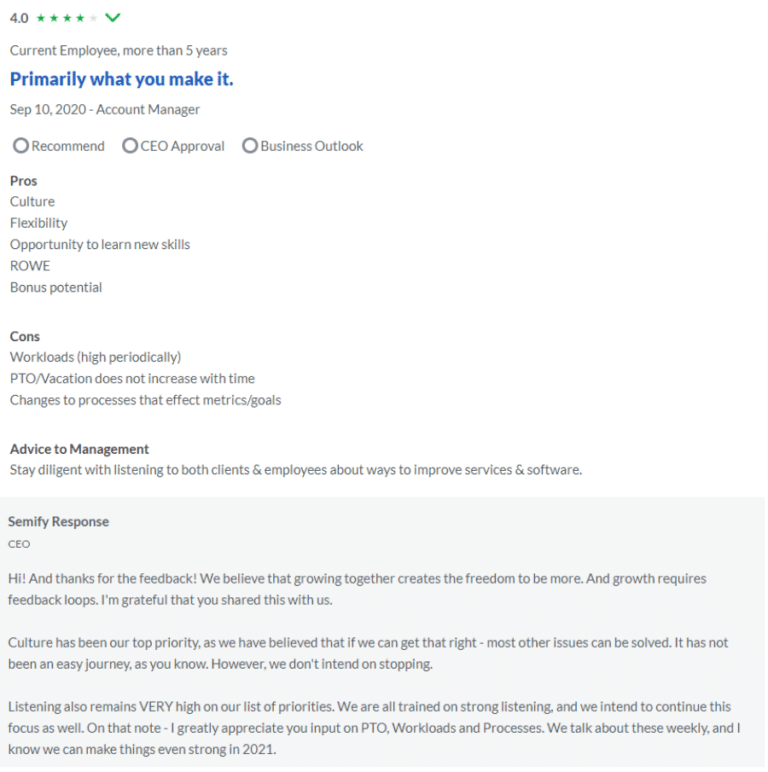
The reviewer here didn’t go into a lot of extra detail, so the response is understandably a bit on the short side. There are a lot of pluses mentioned, and the minuses were fair to point out at the time. As a team, our goals have evolved since 2020. We’ve also done a lot of work to make workloads more manageable while striving for a high-performance culture.
One of the first things we do when responding to any review is to thank the individual for sharing their thoughts. We’re a learning organization at heart, which means that feedback truly is a gift. It’s how we grow together… which perfectly ties into our mission as a company.
We addressed the majority of the reviewer’s points while driving home our values. In this case, the employee isn’t citing a bad experience – and they were still with us after 5+ years! – so this kind of response feels appropriate for the situation.
TIP: Whether the reviewer is a current or former employee, it’s crucial that you not attempt to identify the person in your review. (Glassdoor even cautions employers to ensure anonymity in their responses.) You might be able to narrow it down if you know your people well enough, but the reviewer’s identity ultimately doesn’t matter. They should feel validated in their experience no matter what.
When you receive a Glassdoor review like this, you’ll typically want to thank the reviewer for their feedback, restate the positives, reaffirm your brand values, and give a sense of what improvements you could make in the future.
Review #2: An Opportunity to Evolve
We know that we aren’t always going to get it right. The key is to learn from our past mistakes and take actionable steps to improve.
One example of that can be seen in how our internal structure has shifted in recent years. Prior to our rebranding, we had a team of dedicated content writers who frequently felt like they were drowning in work. Due to the workload, they often felt isolated and unable to balance their goals with other cultural opportunities. This, combined with lower-than-average compensation, led to high rates of burnout and turnover. As a company, we felt stuck with this structure we had created – until we received important feedback from current and former employees that changes needed to be made.
At the same time, we were experimenting with what we now call the “Matrix” structure. This new way of working was more team-oriented, allowed for a greater variety of work, and gave employees a greater sense of ownership over their jobs.
Thanks to the feedback we received and the innovation led by our team members, we were able to find a better way forward. We now have a team of highly trained Digital Marketing Specialists (many of whom started out on our content team) who have real opportunities for growth within the organization. We’ve also created other positions that didn’t exist just a few short years ago in order to support our employees who want to build their careers at Semify.
Knowing this background can be helpful in understanding how to respond to Glassdoor reviews like the one below.
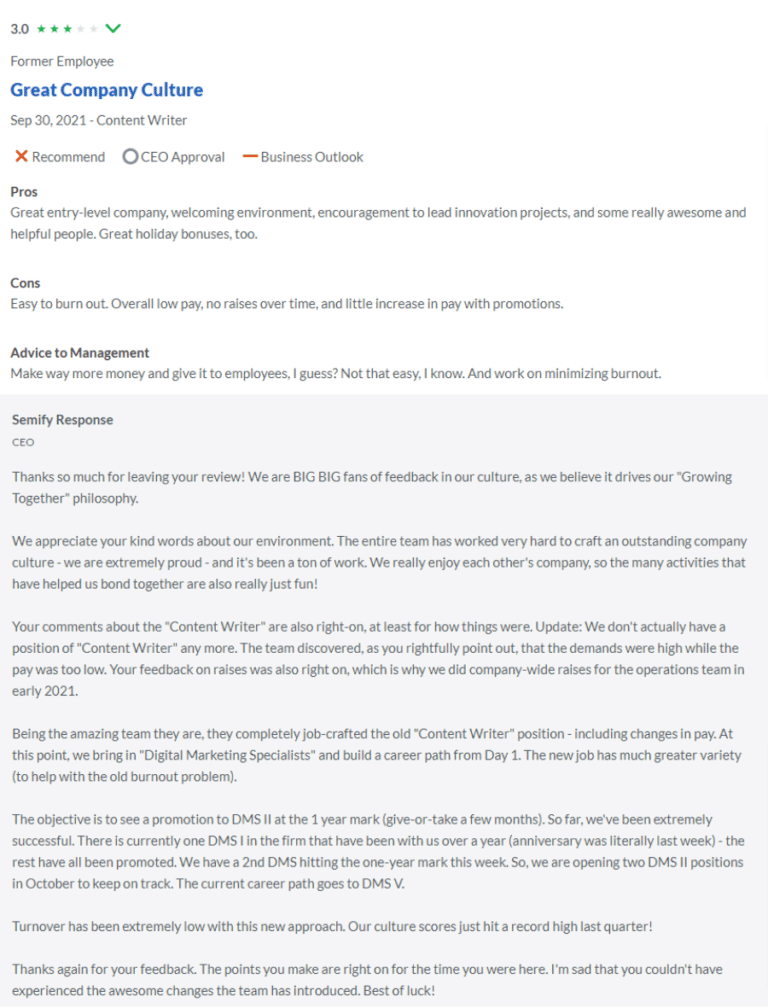
Although this review was published in 2021, we realized from the job title that this employee had left prior to this restructuring. They didn’t include a ton of information in their review, but we felt that the mentions of burnout and compensation warranted a lengthier explanation.
We’re sad that this employee wasn’t able to benefit from all of the changes we made after their departure. Admittedly, it took us far longer to address these concerns than we would have liked. However, their review provided an awesome opportunity for us to be clear about the steps we had taken to show future employees that we care, that we’re not afraid of change, and that we’re always striving to do better.
This exact scenario could play out for your business. As people leave for other opportunities, they may miss out on the work you’re doing to improve. Showing them the actions you’ve taken – without getting defensive! – can entice potential employees and demonstrate you’re committed to making things better.
Review #3: Culture Is a Real Stand-Out
In years past, our culture was lacking. We’re the first to admit it. That’s why we’ve worked so hard to make our culture what it is now. And while we know we can always improve, we’re thrilled to see that even new employees feel that Semify is a special place to work.
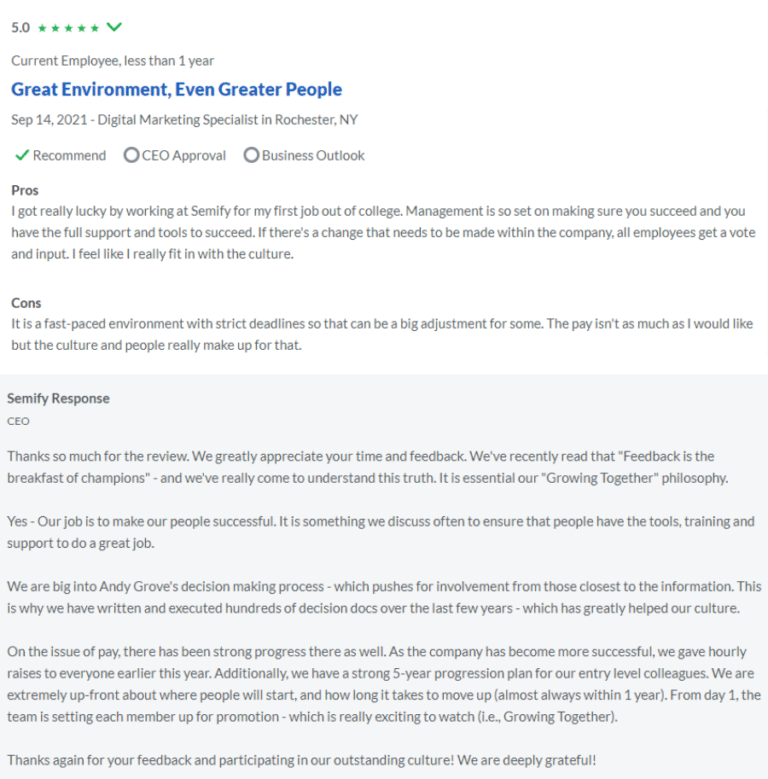
This reviewer hadn’t been part of the team for very long when they left us a review, but we feel this means we’re doing something right. Our hiring, onboarding, and training processes have improved a lot over the past few years, so it’s a relief to hear that our newest team members feel welcomed, supported, and empowered.
At the same time, we’ve always known that Semify isn’t going to be the right fit for everyone. We grew a lot in 2021, which meant there was often more than enough work to go around. And while our job positions have evolved quite a bit, we know that compensation is a top priority for today’s workforce – and that we need to find ways to stay competitive.
In our response here, we expanded on some positives mentioned by the reviewer, like our decision-making process. We also noted our promotion paths and raises as a way to answer the reviewer’s concerns about compensation. Although we could have done a bit more to address the fast pace of our work environment and how we’d like to increase pay even for entry-level positions, we highlighted our gratitude, appreciation, and overall ethos in our response.
When learning how to respond to Glassdoor reviews like this one, you’ll want to echo the reviewer’s positive points, expand on your values, and show the progress you’ve made as a company. Bonus points if you can show how passionate you are!
Review #4: A Tough Pill to Swallow
No job is ever going to be perfect and there will always be things we can improve on. But for the most part, we’re pretty lucky in that most of the employee reviews we receive on Glassdoor are positive.
We feel it’s important, though, to be transparent about where we’ve failed and how we’ll do better in the future. Even reviews that contain some harsh criticism tend to include some positives, but it can be tough to keep emotions at-bay when we’ve worked hard to make improvements. We know how important it is to be accountable and to recognize that we always have room to grow together.
TIP: When this review came in recently, several members of our management team met to discuss how we’d respond. This is a strong policy to have in place for reviews like this one, as it can keep you from getting defensive or having blind spots. See what the reviewer had to say and how we responded below.
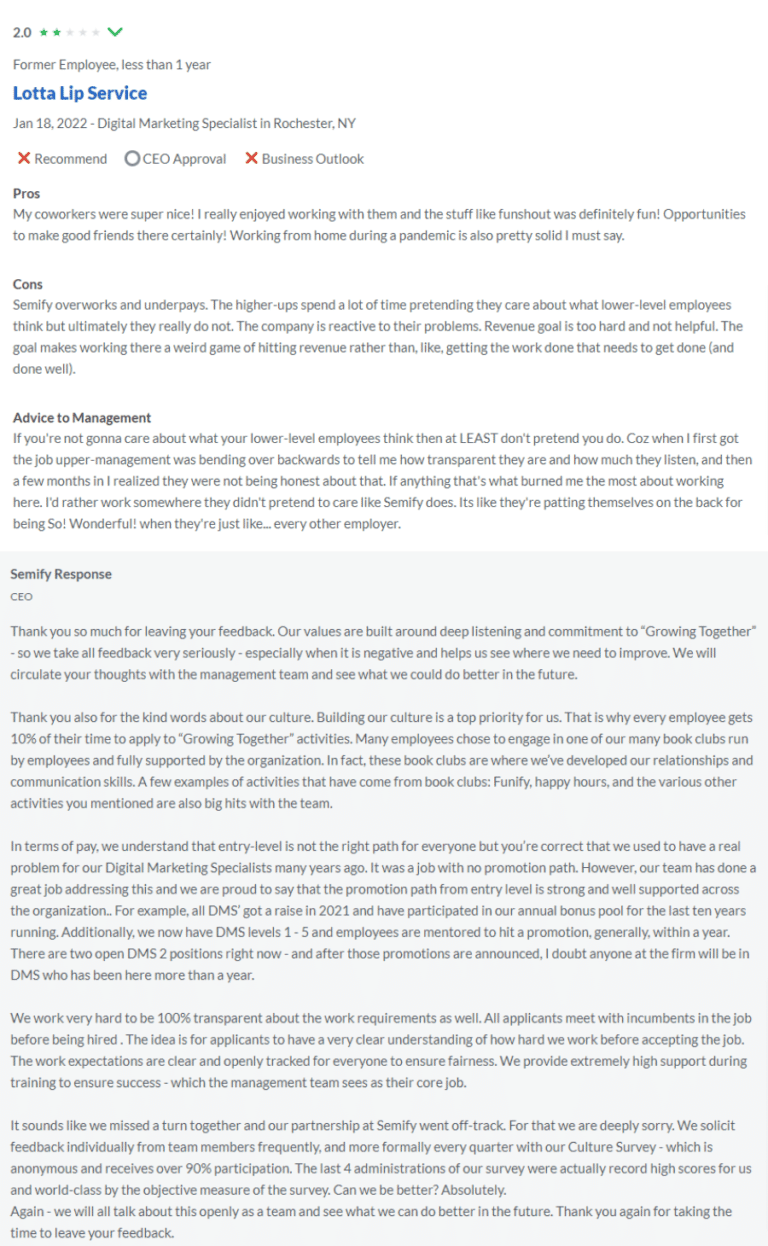
Truthfully, this one stung. But rather than ignore it or strike back, we decided to take this opportunity to really lean into what Semify is all about.
In this scenario, we wanted to give a bit more background information. While it’s clear the reviewer had been a Digital Marketing Specialist with us during the pandemic, we weren’t sure whether the reviewer had been on the team when we made across-the-board changes to compensation.
We also felt it was appropriate to apologize for the reviewer’s experience and let them know we value negative feedback. Additionally, we feel that it’s sometimes fair to include what might have been left out of the initial review. This should never turn into a personal attack or an ego trip, but discussing the processes you have in place to remedy these situations can be helpful to other readers.
The truth is that we care deeply about our team – and it hurts to hear that we didn’t do a good job of showing it with this former employee. We always strive to do better. At the same time, there’s more than one side to this story. There may have been other factors at play that impacted this employee’s experience, but that doesn’t negate our responsibility to do better in the future.
This review may not have been what we love to read. However, it’s a good reminder that we can’t let the work we’ve done fall by the wayside. We have to keep going – and growing together.
At some point, your company might receive a review like this. You might have already gotten a few of them. It’s easy to feel discouraged, but remember: negative reviews are actually opportunities in disguise.
Whether or not the reviewer’s account aligns with your version of events is irrelevant. You’ll want to validate their feelings, apologize for your shortcomings, and cite improvements that you’ve already made to break this cycle in the future. Prospective hires will probably care more about how you respond to this type of review than the review itself.
Review #5: Ending on a High Note
Knowing how to respond to negative reviews on Glassdoor is a skill that can be honed over time. But these days, we receive a lot of positive feedback – and we know it’s important to respond to these reviews, as well.
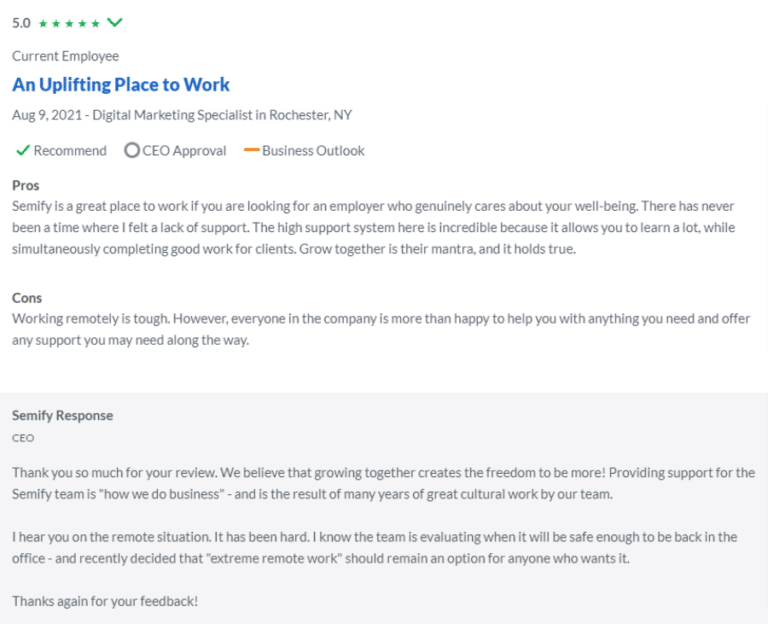
Glassdoor readers might trust reviews from former employees over current employees, as they may not know what kind of office politics are coming into play. However, we value this kind of feedback because it provides us with an opportunity to improve our practices and benefit the reviewer.
When a former employee leaves a review, it’s typically too late to make any changes that would have made a difference in their personal experience. Of course, we can take steps to keep those scenarios from repeating themselves for others. But we’d ideally like to have the chance to address feedback before it reaches a critical point and results in turnover.
Interestingly, this reviewer feels that remote work is a major challenge (whereas the previous reviewer cited it as a plus). This difference in opinion is mirrored in our team as a whole; many are eager to return to the office once it’s safe, while others want to continue working remotely 100% of the time.
We wanted to highlight the decisions we’ve made as a team and demonstrate our commitment to radical autonomy and ensuring our employees have the ability to work in a way that best fits their needs. Since we know that remote work is in huge demand among job-seekers, addressing flexible work arrangements (or how you’ll specifically handle the need for a hybrid work environment) in your responses can go a long way.
We love hearing that this employee feels supported at Semify. It’s also reassuring to hear that our mantra of “growing together” really does resonate. To us, it isn’t just a catchy phrase; it’s a way of life. We did a lot of work during our rebranding phase and we feel it shows in our identity and our culture today.
With a short-and-sweet review like this, you’ll want to express gratitude, empathize with their struggles, and give a shout out to your team. If they mention remote work options, seize the opportunity to expound on what you offer. Give credit where credit is due and show how you’ll keep putting your people first. Your response can impact how long the reviewer sticks around!
Whether positive or negative, responding to reviews on Glassdoor requires patience, compassion, and humility. We hope that sharing how we’ve responded to rave reviews and valid criticisms will help guide you in your own responses.
Knowing How to Respond to Glassdoor Reviews is Only the Beginning
We’ve done a lot of work over the past few years to improve our business from the inside out. Not only does that mean we’ve improved our products, but we’ve also made our people a top priority.
During this process, we’ve also had to take a hard look at ourselves and where we were coming up short. In the past, we had high levels of turnover – and we know that a lot of that was attributed to low compensation, stressful workloads, and a lack of support. We’ve made a lot of mistakes with our business in the 14+ years we’ve been around.
So why are we sharing this?
It might seem weak to admit your shortcomings, but we’ve learned that doing so has made us a lot stronger. And one of the biggest factors in making these necessary changes was actually our employee feedback. Although some of what was said was difficult for us to hear, we knew how important it was to listen and to prevent these situations from happening in the future.
In 2019, we actually held a series of meetings to discuss some of our Glassdoor feedback with our employees. We actively wanted to make their experience better and we knew that empowering our people was one of the best ways to accomplish that. What came out of those meetings was incredibly valuable to our company. It prompted us to make huge changes to our internal structure, our compensation, our culture, and our entire direction as a business.
We’re still growing and learning from every single review. And while it starts with how you choose to respond to that public feedback, it can’t end there. Take that feedback to heart and use it to make meaningful changes within your organization. Your business will be all the better for it. We promise.
Recent Posts